
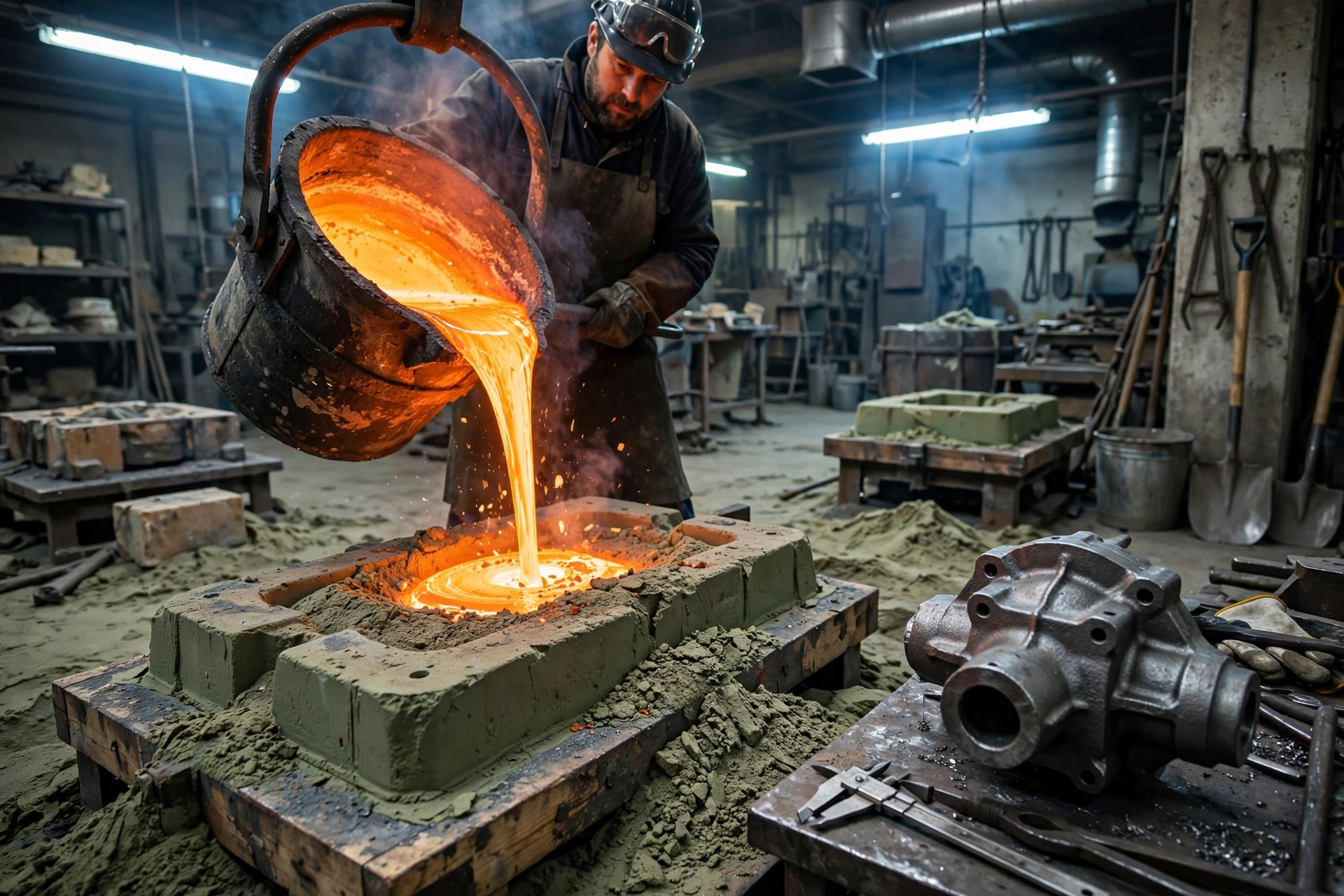
Hello Guys, Welcome back to ELearnInsight. Today we are going to explore one of the well-known manufacturing processes, the casting process. If you visit Asia’s largest industrial hub, then you will find many metal parts manufacturing companies. and furthermore, if you visit such manufacturing companies you will find Engine blocks, Kitchen taps, Turbine blades, Manhole covers, Industrial equipment, etc. These items are made from a casting process. Casting has played an important role in human civilisation from the Bronze Age and still plays a great role in the manufacturing of daily-running machines. Let’s see why a manufacturer chooses the casting process.
In this blog you will understand the types of casting as well as the difference between sand casting and die casting. In addition to it, you will also come to know about investment casting and centrifugal casting.
What is casting? Definition:
The manufacturing process in which a molten metal, i.e., liquid metal, is poured into the mold cavity with the help of gravity, pressure and centrifugal force and let to cool to solidify to get the desired shape; later, the finished product is removed from the mold. This process is called the casting process.
In the machining process, the raw material is a solid block, and the machine removes the material from it to get a final product. And in the casting process, the product build is very much close to the final product. It results in manufacturers having less waste of material, and furthermore, manufacturers use the casting process to develop complex geometry in a single step. Foundries use this technique across automotive, aerospace, construction, and energy industries, in addition to art and jewellery industries, in order to reach its extent beyond heavy industry.
Why Do Manufacturers Choose Casting Over Other Processes?
The casting process has several practical advantages; hence, it has survived for thousands of years and is still in competition with modern manufacturing processes like 3D printing and CNC machining.
1. Ability to handle complex shapes:
Casting handles complex shapes very easily. In casting internal passages, thin walls, intricate curves, etc. are often poured in minutes. and the same process would take hours to machine. Some curves and shapes with cavities are almost impossible to machine but can be achieved by this casting process.
2. Ability to work with any metal:
Casting works with almost any metal. Aluminium, iron, steel, bronze, zinc, magnesium, and titanium, all these metals are used in one or another casting method. As per the application, metals are used in the casting process. In jewellery applications, casting works with gold, silver, and other expensive metals.
3. Mass production:
This is one of the great advantages of the casting process. Casting can scale the production very well. A single wooden pattern of cast can produce hundreds of sand moulds; moreover, a steel die can stamp out millions of identical die-cast parts. It plays an important role in creating raw material for final machining parts. It eliminates unnecessary machining time. In addition to this, it saves time and material cost and results in mass production of components.
4. Reduction in assembly time:
Machined blocks and plates are joined together by bolting and welding processes to get a definite shape. This results in an increase in assembly time. In a casting process, this shape is achieved in a single step with the advantage of uniform structure of a component.
Casting is one of the most widely used manufacturing processes, but it also comes with a few challenges. If the process is not controlled properly, defects such as porosity, shrinkage, and rough surface finish can appear in the final part. To overcome these issues, engineers use different types of casting processes. Each method has its own strengths and is chosen based on factors like production cost, required accuracy, part size, surface finish, and the number of parts to be produced. Selecting the right casting method helps achieve better quality while keeping manufacturing efficient and cost-effective.
.
The core steps involved in the casting process.
Although different casting methods have their own unique features, most of them follow the same basic sequence of steps. Below are the steps mentioned.
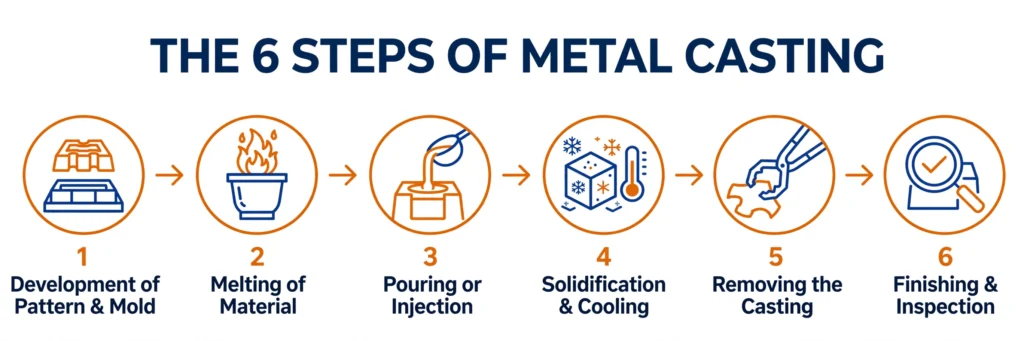
- Development of pattern and mold: Initially, the pattern is developed; that pattern has a similar shape to that of the final product. This pattern is used to prepare the mold with materials like sand and wax, depending upon casting process
- Melting of Material: After mould creation, the next part that comes into action is heating and melting the material. The selected metal is heated in a furnace until it becomes completely molten. The melting temperature depends on the material—for example, aluminium melts at around 660°C, while steel requires temperatures above 1,500°C.
- Pouring or injection process: Once the metal reaches the required temperature, it is transferred into the mold cavity. Depending on the casting process, the metal may enter the mold by gravity, vacuum assistance, or high-pressure injection.
- Solidification and cooling: Inside the mold, the molten metal cools and solidifies, taking the exact shape of the mold cavity. The cooling rate plays an important role in determining the casting’s grain structure, strength and mechanical properties and overall quality.
- Removing the casting: After the casting has cooled sufficiently, it is removed from the mold. Disposable sand molds are broken apart, while permanent metal molds are simply opened so the part can be taken out.
- Finishing and Inspection: The final step involves removing excess material such as gates, runners, and flash. Depending on the application, the casting may also undergo grinding, sandblasting, machining, polishing, and quality inspection to achieve the required dimensions and surface finish.
Let’s explore the major types of casting processes and see how each one modifies these steps to suit different materials, production volumes, and engineering requirements.
Types of Casting Processes.
1. Sand Casting
Sand casting is the oldest and most wisely used casting method in the world. Many foundries still find sand casting better because it gives more flexibility with low tooling costs.
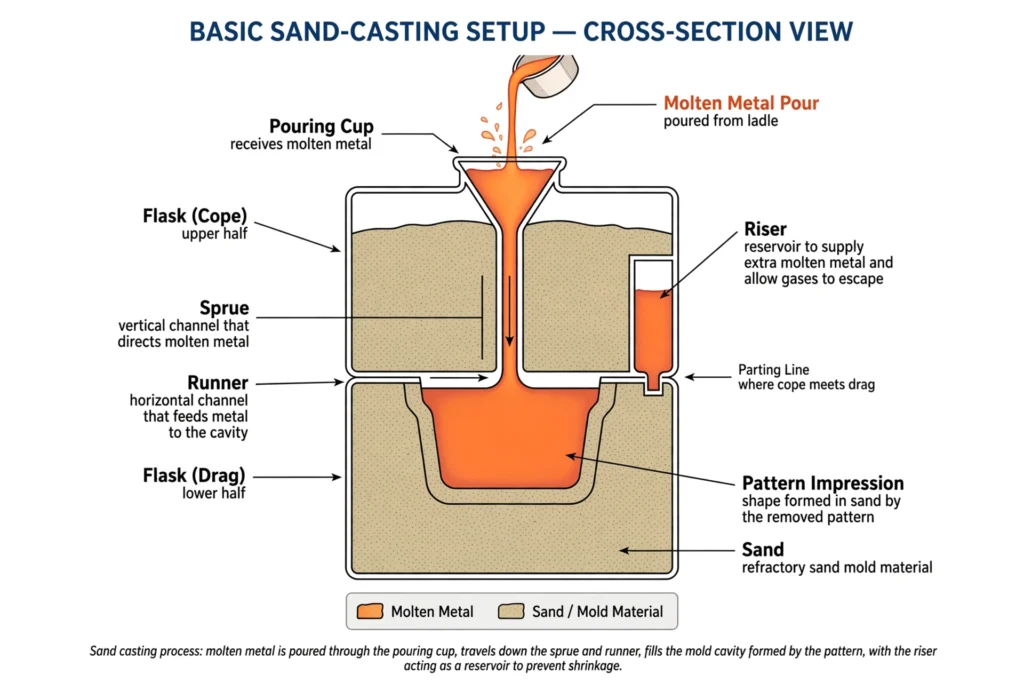
In the sand casting process, the operator presses a pattern into a mixture of sand and clay binder to form the two halves of a mould. The operator then removes the pattern to create a cavity that matches the shape of the required component. Next, the operator assembles the mould halves and pours molten metal into the cavity through a sprue. After the metal solidifies, the operator breaks the sand mould to remove the casting. Finally, the operator cleans and finishes the casting according to the required specifications.
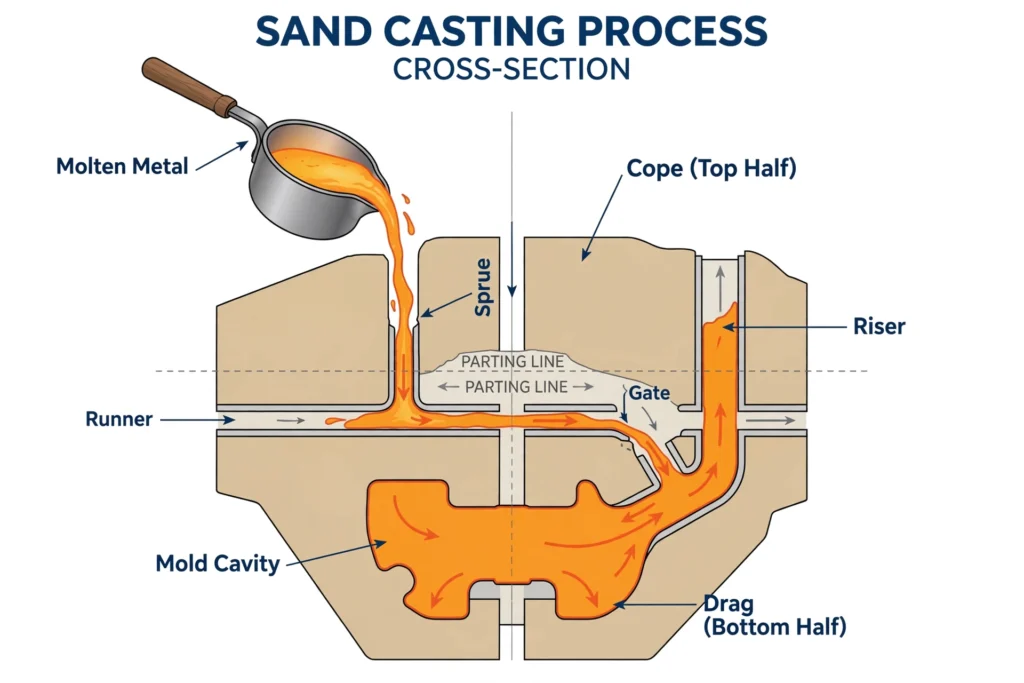
Some large parts, like automotive engine blocks and heavy housings of machines, are made from sand casting because sand casting is comfortable with handling large parts. It also works great with the metals having high melting points like steel and cast iron. Many sand casting parts require machining afterwards, because at the downside of casting, the surface finish gets a bit rough.
2. Die Casting
Die casting is also one of the well-known manufacturing casting processes. This process uses hardened steel dies, a hot chamber furnace and an injector. The injection system injects molten metal from the hot furnace into the moulds under high pressure. The pressure helps the molten metal fill the mold completely. This creates detailed and accurate parts.Since the die is reusable, manufacturers can produce thousands or even millions of identical components. These identical components get tight tolerances and a smooth surface finish. Hence die casting is an efficient and cost-effective solution for high-volume production.
Die casting uses two main methods, a hot chamber and a cold chamber. In hot-chamber die casting, the machine melts and injects low-melting-point metals, such as zinc, directly from its built-in furnace. This method speeds up production. In cold-chamber die casting, manufacturers melt the metal in a separate furnace and then transfer it to the injection chamber. They use this method for aluminium because it prevents the metal from corroding the casting machine.
Two main variations exist here. Hot-chamber die casting keeps a furnace built directly into the machine, which works well for low-melting-point metals such as zinc. Cold-chamber die casting, on the other hand, melts the metal separately and then transfers it into the injection chamber — a better fit for aluminium, which would corrode a hot-chamber machine over time.
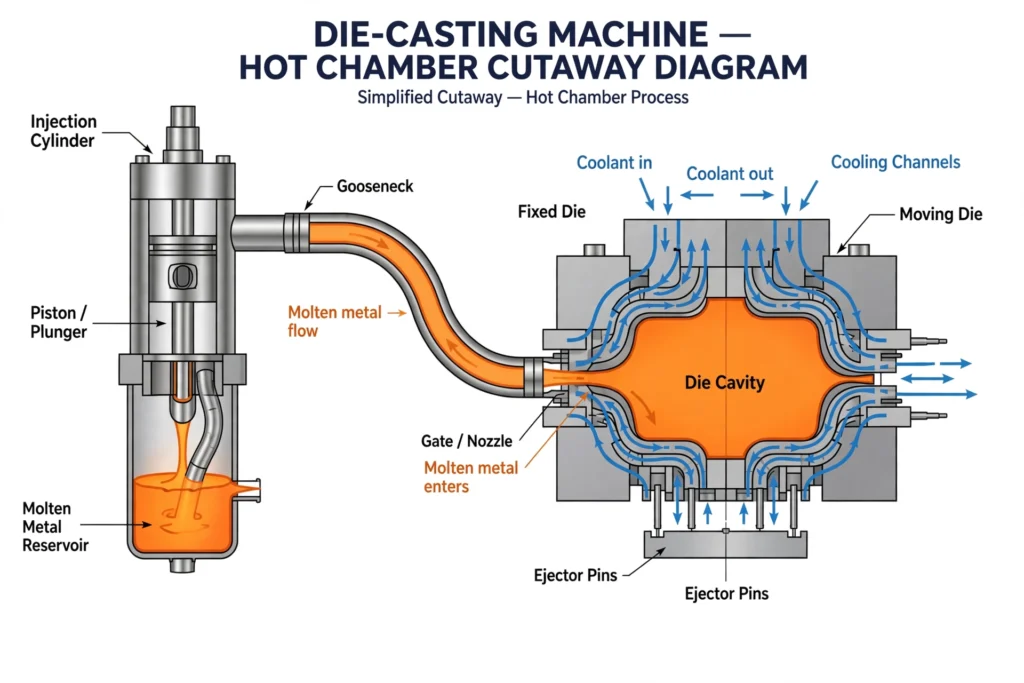
Manufacturers use die casting to produce electronics housings, automotive transmission components, and small hardware fittings. They choose this process when they need fast production, consistent quality, and highly repeatable parts rather than large-sized components.
3. Investment Casting
Investment casting, also known as lost-wax casting, it produces highly detailed and precise metal parts.
The process begins by creating a wax pattern of the final component. Manufacturers attach multiple wax patterns to a central wax stem to form a structure called a tree. They then dip the tree into a ceramic slurry several times to build a strong ceramic shell.
Once the shell hardens, they heat it to melt and remove the wax. This step leaves behind a hollow ceramic mold, which gives the process its name—lost-wax casting. Next, they pour molten metal into the mold. After the metal cools and solidifies, they break the ceramic shell to remove the finished casting.
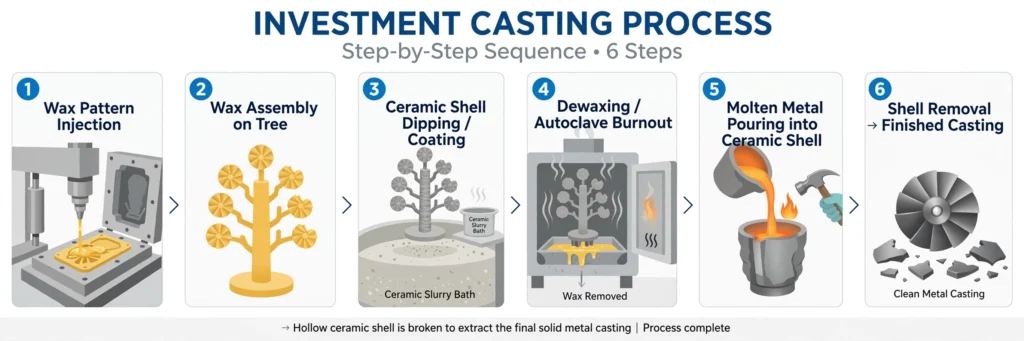
Manufacturers use investment casting when they need complex shapes, fine details, and excellent dimensional accuracy. The process works well for aerospace turbine blades, surgical instruments, and intricate jewellery. Although it delivers exceptional quality, it takes more time and costs more than sand casting or die casting because of its multiple production steps.
4. Centrifugal Casting
Centrifugal casting produces strong and high-quality metal parts by spinning the mold at high speed during casting. As molten metal enters the rotating mold, centrifugal force pushes it against the mold walls. This force helps remove trapped gases and impurities by driving them toward the center, resulting in a denser and cleaner casting.
Manufacturers mainly use this process to produce cylindrical and tubular components such as pipes, rings, bushings, and sleeves. Depending on the application, they choose from three types of centrifugal casting: true centrifugal casting for hollow parts, semi-centrifugal casting for solid components, and vertical centrifugal casting for shorter or more complex cylindrical shapes.
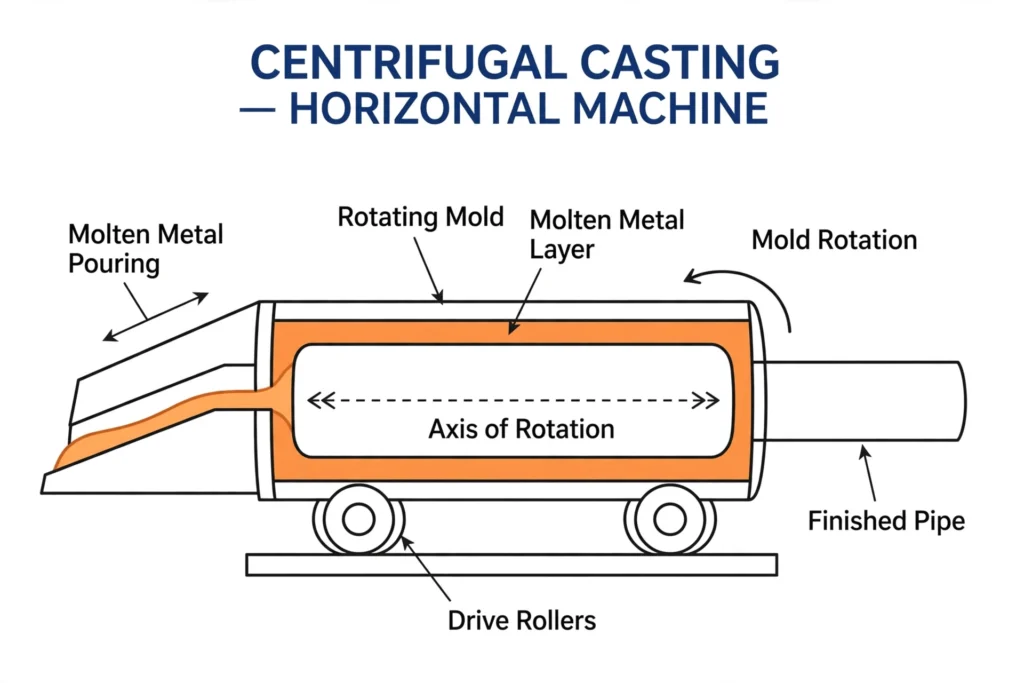
Because the process naturally reduces porosity and improves material strength, industries such as aerospace, energy, and heavy machinery rely on centrifugal casting to manufacture durable, high-performance components.
5. Permanent Mold Casting
Permanent mold casting uses a reusable metal mold to produce metal parts. Manufacturers pour molten metal into the mold using gravity instead of high pressure. Since the mold is made of metal, it cools the molten metal quickly. This faster cooling creates a finer grain structure and improves the strength and durability of the finished part. Manufacturers typically use this process for low-melting-point metals such as aluminium, magnesium, and certain copper alloys. These metals help extend the life of the reusable mold and ensure consistent production.
Permanent mold casting is a popular choice for manufacturing kitchenware, small engine components, lighting fixtures, and other medium-volume products. It offers a good balance of quality, durability, and production cost, making it ideal for applications that require consistent and reliable parts.
6. Continuous Casting
Continuous casting produces metal in a continuous and efficient process. Manufacturers pour molten metal into a water-cooled mold, where it begins to solidify as it moves through the system. The solidified metal exits the mold as a continuous strand, which they then cut into slabs, billets, or bars. Steel manufacturers widely use continuous casting because it delivers consistent quality while reducing material waste and contamination. The process also improves production efficiency, making it the preferred choice for large-scale metal manufacturing.
Common Casting Defects and Their Remedies
Even well-controlled foundries can experience casting defects, which is why quality control is essential throughout the manufacturing process. One common defect is porosity, which occurs when trapped gas or metal shrinkage creates small internal voids. These voids can weaken the casting. Cold shuts form when two streams of molten metal fail to fuse completely, leaving a visible seam. Warping occurs when uneven cooling distorts the shape of the finished part.
Manufacturers reduce these defects by designing parts with uniform wall thickness. This helps the metal cool evenly and lowers the risk of cracking. They also add fillets to internal corners to improve metal flow and reduce stress concentration. Finally, engineers use non-destructive testing methods, such as X-ray inspection and industrial CT scanning, to detect internal defects without damaging the finished casting.
Real-World Applications of Casting
Metal casting plays a vital role in many industries and everyday products.
Automotive: Manufacturers use casting to produce engine blocks, transmission housings, suspension components, and other critical vehicle parts.
Aerospace: They rely on investment casting and centrifugal casting to manufacture turbine blades and structural components with high strength and precision.
Construction: Casting helps produce durable pipe fittings, valves, manhole covers, and other infrastructure components.
Medical Devices: Manufacturers use investment casting to create surgical instruments and implant components with exceptional accuracy and biocompatible materials.
Everyday Products: Many common items, including doorknobs, cookware, and lighting fixtures, are made using permanent mould casting or die casting.
Conclusion
Metal casting remains one of the most versatile and reliable manufacturing processes. Whether you need the simplicity of sand casting, the speed of die casting, the precision of investment casting, or the strength of centrifugal casting, there is a casting method to match your requirements. Understanding the strengths of each process helps engineers, product designers, and manufacturers choose the most suitable option. The right choice improves product quality, reduces production costs, and increases manufacturing efficiency.
Before selecting a casting process, consider three key factors: the required production volume, the complexity of the part, and the type of metal or alloy. Once you evaluate these requirements, choosing the right casting method becomes much easier.
Stay tuned for more manufacturing processes.
If you wish to have an overview of other manufacturing processes, please refer to the below blog link.
Disclaimer: Some visuals in this article have been created using AI-generated imagery to help explain manufacturing concepts. These images are for illustrative purposes only and should not be considered exact representations of equipment, products, or industrial processes. Thank you.