
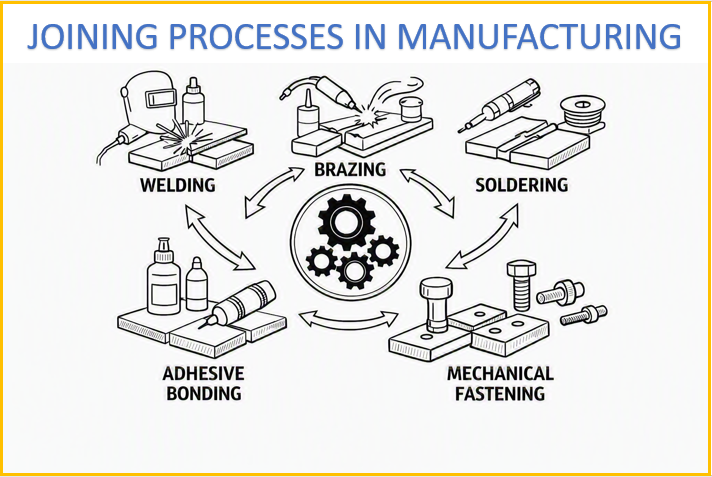
Hello, and welcome to ELearnInsight. If you visit any manufacturing plant, you will find many assemblies in which the components are joined together. Manufacturing rarely stops at shaping a single part. Most products need two or more components joined into one working assembly. That is where the joining process in manufacturing comes in. Also, it is one of the four fundamental manufacturing categories, alongside casting, forming, and machining.
However, engineers, students, and shop-floor professionals across the manufacturing sector face the same question every day. Which joining method fits this job? Pick the wrong process, and you risk weak joints as well as wasted material or costly rework. Pick the right one, and you get a strong, reliable, and cost-effective product.
Moreover, this guide walks through every major joining process used in modern industry. You will learn how each method works, which equipment it needs, and when to use it. As a result, you will have a practical, real-time reference for joining process selection.
What Is a Joining Process in Manufacturing?
A joining process combines two or more parts into a single assembly. Engineers use it when a product is too complex to make as one piece or when different materials must work together in one unit. Consequently, joining sits right beside casting, forming, and machining as a core manufacturing category.
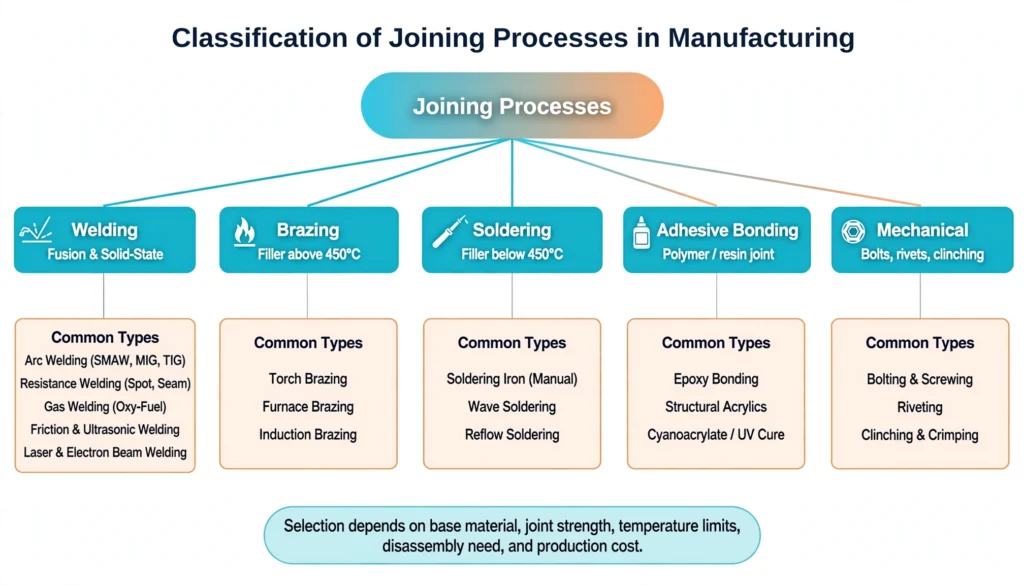
Further, joining processes fall into five broad families:
- Welding
- Brazing
- Soldering
- Adhesive bonding
- Mechanical fastening
Each family covers a range of specific techniques. Together, they cover almost every material combination you will meet in industry, including steel, aluminum, plastic, and composite parts.
Why Joining Process Selection Matters
Choosing the correct process affects several outcomes directly, so it deserves careful thought before production starts.
- Strength: A joint must survive the actual service loads, not just look solid.
- Cost: Labor, equipment, and consumables vary hugely between methods.
- Speed: Mass production needs fast, repeatable joints, while prototyping does not.
- Material compatibility: Some metals crack or corrode when welded together. Others need a different approach entirely.
- Safety and code compliance: Structural and pressure-vessel work often follows strict codes such as ASME, AWS, ISO, and EN standards.
If the selection goes wrong, defects surface later, in the field rather than in the factory. Therefore, selection deserves the same attention as the design itself.
Main Categories of Joining Processes
Below, we break down each family: how it works, its typical procedure, and the equipment it requires.
1. Welding
Welding fuses two materials together, usually with heat and pressure, or both. It creates the strongest possible joint because it forms a true metallurgical bond between the parts. Automotive frames, pressure vessels, and pipelines, as well as structural steel, all rely on welding.
Additionally, welding splits into three broad groups: fusion welding, solid-state welding, and specialized high-energy methods like laser and electron beam welding.
Arc Welding
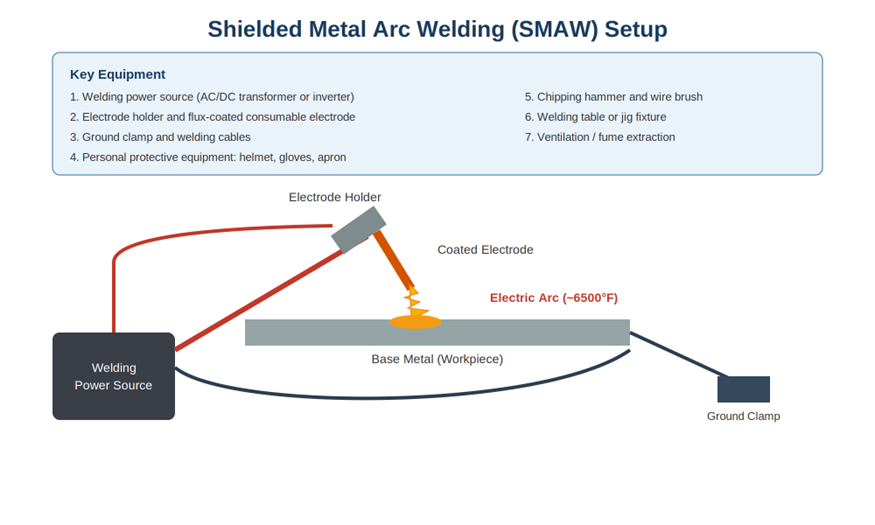
Arc welding uses an electric arc between an electrode and the workpiece to generate intense heat, often above 6,000°F (3,300°C). That heat melts the base metal and, in most cases, a filler metal too.
- SMAW (Stick Welding): Uses a flux-coated consumable electrode. It is portable, low-cost, and well suited to outdoor and repair work.
- GMAW (MIG Welding): Feeds a continuous wire electrode through a gun, shielded by inert gas. It is fast and easy to automate, so it is popular in automotive and sheet-metal work.
- GTAW (TIG Welding): Uses a non-consumable tungsten electrode with a separate filler rod. It produces clean, precise welds, which makes it a favorite for aerospace and stainless-steel work.
- FCAW (Flux-Cored Arc Welding): Similar to MIG welding, but it uses a tubular, flux-filled wire. As a result, it handles thicker sections and outdoor conditions well.
Equipment: welding power source (transformer or inverter), electrode holder or welding gun, shielding gas cylinder for MIG and TIG, ground clamp, welding cables, and personal protective equipment such as a helmet, gloves, and apron.
Resistance Welding
Resistance welding passes electric current through two overlapping metal sheets. Resistance at the contact point generates heat, and applied pressure forms the bond. Notably, no filler metal is needed.
- Spot welding: Joins sheets at discrete points and is the standard method in car-body assembly.
- Seam welding: Creates a continuous, leak-tight seam, commonly used for fuel tanks and containers.
Equipment: resistance welding machine, copper-alloy electrodes, transformer, and a pressure or force control system.
Gas Welding
Oxy-fuel, or oxy-acetylene, welding burns a fuel gas with oxygen to produce a flame around 6,000°F. This flame melts the base metal and filler rod together.
Equipment: oxygen and acetylene cylinders, pressure regulators, a torch, hoses, filler rod, and a flint lighter. Although gas welding is slower than arc welding, it works well for thin sheet metal, pipe work, and repair jobs where portability matters most.
Solid-State Welding
These processes join metal without melting it. Instead, heat, pressure, or both deform the material until atoms bond across the interface.
- Friction welding: Rotates one part against another under pressure. Friction heat forms the bond, which suits shafts and dissimilar-metal joints.
- Ultrasonic welding: Uses high-frequency vibration to bond thin metals or plastics, common in electronics and packaging.
- Explosion welding: Uses controlled explosive force to bond dissimilar metal plates, such as cladding steel with titanium.
- Diffusion welding: Applies heat and pressure over time, letting atoms diffuse across the joint. This method is common in aerospace and nuclear components.
Laser Beam and Electron Beam Welding
These high-energy methods focus a laser or electron beam onto a tiny spot, producing deep, narrow welds with minimal heat distortion.
Equipment: Eventually a laser source (fiber or CO₂) or an electron-beam gun, a CNC positioning system, a vacuum chamber for electron beam welding, and safety enclosures. Because of its precision, laser welding suits high-precision industries such as automotive, electronics, and medical devices.
2. Brazing
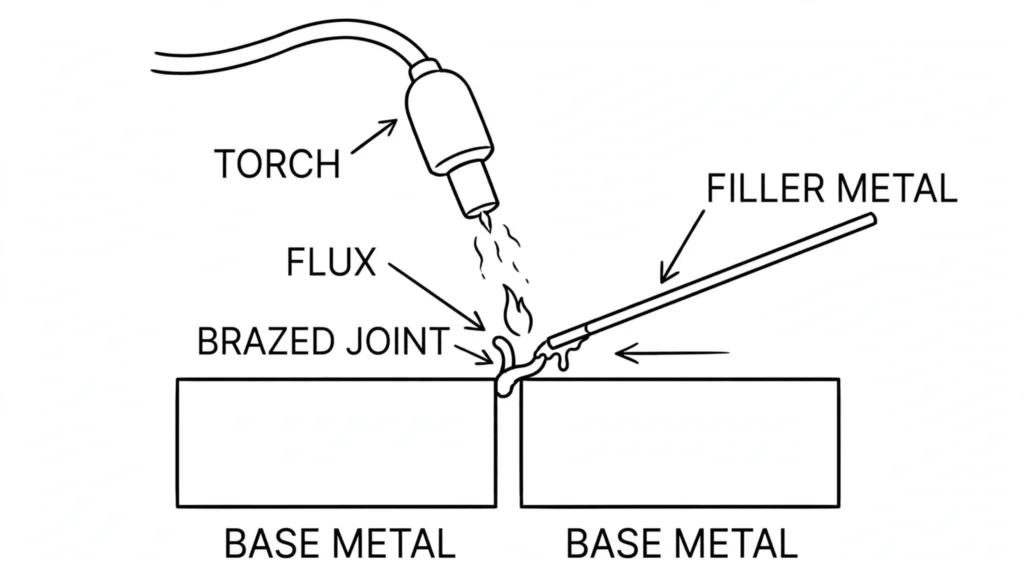
Brazing joins metals using a filler metal that melts above 840°F (450°C) but below the melting point of the base metal. Capillary action pulls the molten filler into the gap between the parts. Since the base metal never melts, brazing keeps the original material properties intact.
Procedure: Clean the joint surfaces, apply flux, position the filler metal, heat the assembly until the filler flows and fills the joint, then cool it and clean off any flux residue.
- Torch brazing: Uses an oxy-fuel torch. It is flexible and low-cost, so it suits small batches.
- Furnace brazing: Heats parts inside a controlled-atmosphere furnace, ideal for high-volume, uniform production.
- Induction brazing: Uses electromagnetic induction to heat only the joint area, making it fast and repeatable.
Equipment: torch or furnace, flux, filler-metal rod or paste (commonly silver, copper, or nickel alloys), and fixtures to hold the parts in position. Brazing works especially well for joining dissimilar metals, such as copper to steel, and it is widely used in HVAC, plumbing, and tool manufacturing.
3. Soldering
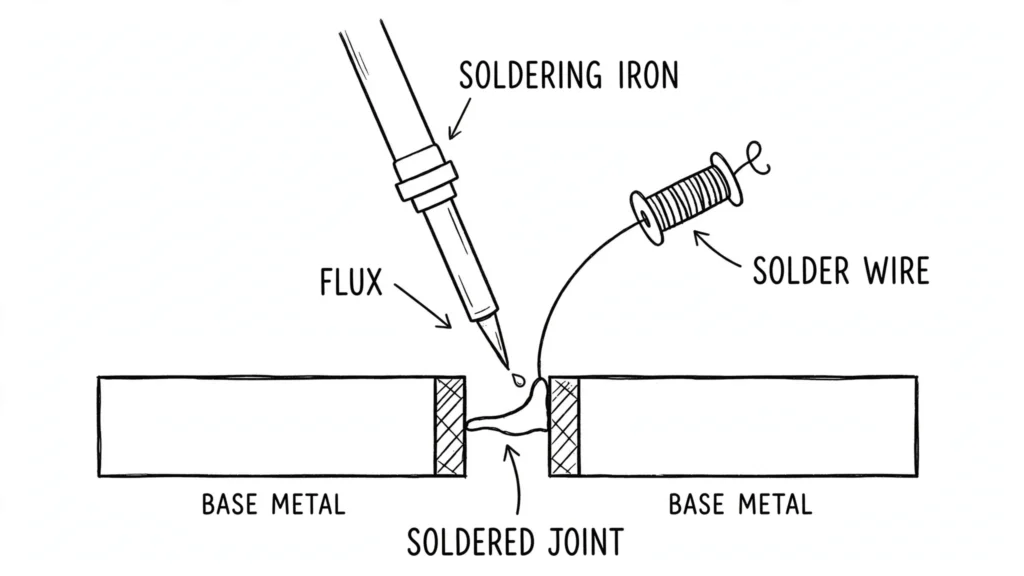
Soldering is brazing’s lower-temperature cousin. The filler metal, called solder, melts below 840°F (450°C), often using tin-based alloys such as Sn-Ag or Sn-Cu.
Procedure: Clean the surfaces, apply flux to remove oxides, heat the joint, feed solder into the joint, and then let it cool.
- Hand soldering: Uses a soldering iron and is the standard method for electronics repair and prototyping.
- Wave soldering: Passes a circuit board over a wave of molten solder, used in mass PCB production.
- Reflow soldering: Heats pre-placed solder paste in an oven, common in surface-mount electronics.
Equipment: soldering iron or gun, solder wire or paste, flux, and a wave-soldering or reflow oven for production lines. Because soldering causes minimal thermal distortion, it remains the standard choice for electronics and electrical assemblies.
4. Adhesive Bonding
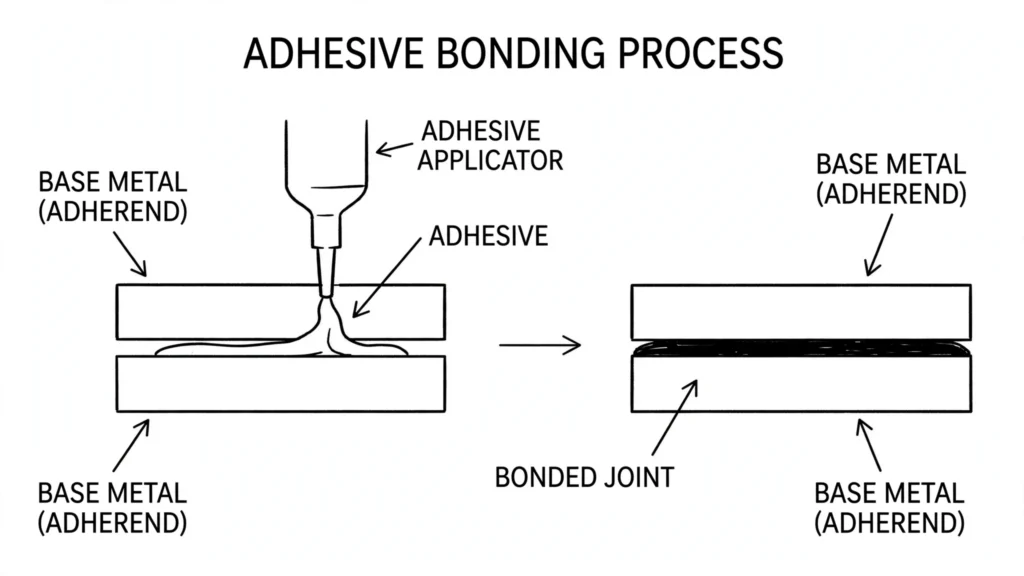
Adhesive bonding joins surfaces using polymer-based adhesives instead of heat or filler metal. It spreads load evenly across the entire bonded area, rather than concentrating stress at a single point like a bolt or spot weld. The joint is also known as a lapping joint.
Procedure: Prepare the surface by cleaning, abrading, or plasma-treating it; apply adhesive; join the parts; then cure the adhesive using heat, UV light, or time.
- Epoxy adhesives: Offer high strength and suit structural bonds.
- Structural acrylics: Cure quickly and tolerate minimal surface preparation.
- Cyanoacrylates (super glue): Form quick bonds for small parts.
- UV-cure adhesives: Cure instantly under UV light, common in electronics and glass assembly.
Equipment: dispensing gun or automated dispensing robot, mixing nozzles, surface-preparation tools, a curing oven or UV lamp, and clamping fixtures. Adhesive bonding shines when joining dissimilar materials, such as metal to plastic or composite to glass, where welding simply is not an option.
5. Mechanical Fastening
Mechanical fastening holds parts together with hardware rather than a metallurgical or chemical bond. Notably, it is the only joining method that allows easy disassembly, which matters for maintenance, repair, and recycling.
Procedure: drill or punch holes as needed, insert the fasteners, then tighten them to the specified torque or force.
- Bolting and screwing: Threaded fasteners allow repeated assembly and disassembly.
- Riveting: Creates permanent fasteners, common in aircraft structures and sheet metal.
- Clinching: Forms an interlock by deforming the sheets together, so no separate fastener is needed.
- Crimping: Deforms a fitting around a wire or tube to form a mechanical grip, standard in electrical connections.
Equipment: torque wrench, pneumatic or electric screwdriver, rivet gun, clinching press, and a drill press.
How to Select the Right Joining Process
Selection depends on several factors working together, not on any single one. Use the checklist below before you commit to a method.
| Factor | Question to Ask |
| Base material | Are you joining similar or dissimilar materials? |
| Joint strength | Does the joint carry a structural load or just hold parts in place? |
| Thickness | A thin sheet needs different heat input than a thick plate. |
| Temperature sensitivity | Can the material tolerate melting-point heat without damage? |
| Production volume | High volume favors automated resistance or laser welding; low volume favors flexible manual methods. |
| Disassembly need | Maintenance or recycling needs favor mechanical fastening. |
| Cost target | Filler metal, equipment, and labor costs vary widely between methods. |
| Code and standard | Aerospace, pressure-vessel, and structural work often mandate specific processes. |
As a quick rule of thumb, use the following starting points, then refine them with the checklist above:
- Structural steel and pressure vessels: arc welding (SMAW, GMAW, or GTAW), following AWS or ASME codes.
- Automotive sheet metal: resistance spot welding or MIG welding.
- Electronics and PCBs: soldering, using wave or reflow methods.
- Dissimilar metals (copper-to-steel, aluminum-to-steel): brazing or adhesive bonding.
- Plastics, composites, and glass: adhesive bonding or ultrasonic welding.
- Parts needing future disassembly: bolts, screws, or rivets.
Industry Applications Around the World
Joining-process demand varies by region, yet the underlying decision logic stays exactly the same everywhere.
- USA: Aerospace manufacturing, oil and gas pipelines, and heavy equipment production drive demand for certified arc welding and orbital welding.
- Europe: Automotive manufacturing, precision engineering, and renewable-energy fabrication (wind turbine towers) lean heavily on robotic MIG and MAG welding, plus laser welding.
- Asia: Electronics manufacturing (soldering and reflow), shipbuilding (submerged arc welding), and automotive mass production (resistance spot welding) dominate the region.
- Middle East: Oil, gas, and petrochemical infrastructure rely on high-integrity pipe welding, typically GTAW root passes with SMAW fill passes, under strict inspection standards.
Wherever you work, the same five-category framework applies. Only the dominant process shifts with local industry priorities.
Common Mistakes in Joining Process Selection
- Choosing a process based on familiarity, not fit: “We have always used MIG” is not a valid engineering reason on its own.
- Ignoring dissimilar-metal compatibility: Some metal combinations cause galvanic corrosion or brittle intermetallic compounds.
- Skipping joint-design review: Even the right process fails with a poorly designed joint geometry.
- Underestimating post-weld treatment: Some welds need stress relief, machining, or inspection before they are production-ready.
- Overlooking code requirements: Structural and pressure-critical joints often need certified welders and documented procedures, such as WPS and PQR records.
Frequently Asked Questions
What is the strongest joining process in manufacturing?
Fusion welding generally produces the strongest joint because it creates a true metallurgical bond between parts. TIG welding and submerged arc welding are especially strong choices for critical structural applications.
What is the difference between brazing and soldering?
Both processes use a filler metal without melting the base metal. However, brazing uses filler metals that melt above 840°F (450°C), while soldering uses filler metals that melt below that temperature.
Which joining process is best for dissimilar metals?
Brazing, adhesive bonding, and friction welding all handle dissimilar metals better than fusion welding, which can crack or form brittle compounds between incompatible metals.
Can adhesive bonding replace welding?
In many cases, yes, especially for dissimilar materials, thin sheets, or applications where even load distribution matters more than peak strength. That said, it is not a direct substitute for high-load structural welds.
Is mechanical fastening reliable for structural work?
Yes. Bolted connections are standard in structural steel construction, and they allow inspection, tightening, and replacement throughout the structure’s service life.
Conclusion
The joining process in manufacturing is not a single technique. It is a toolbox. Welding, brazing, soldering, adhesive bonding, and mechanical fastening each solve a different problem. The best engineers do not default to one method; instead, they match the process to the material, the load, the production volume, and the budget.
Use this guide as your reference the next time you reach the joining-process-selection stage of a project. Bookmark it, share it with your team, and revisit it whenever a new assembly challenge lands on your desk.