
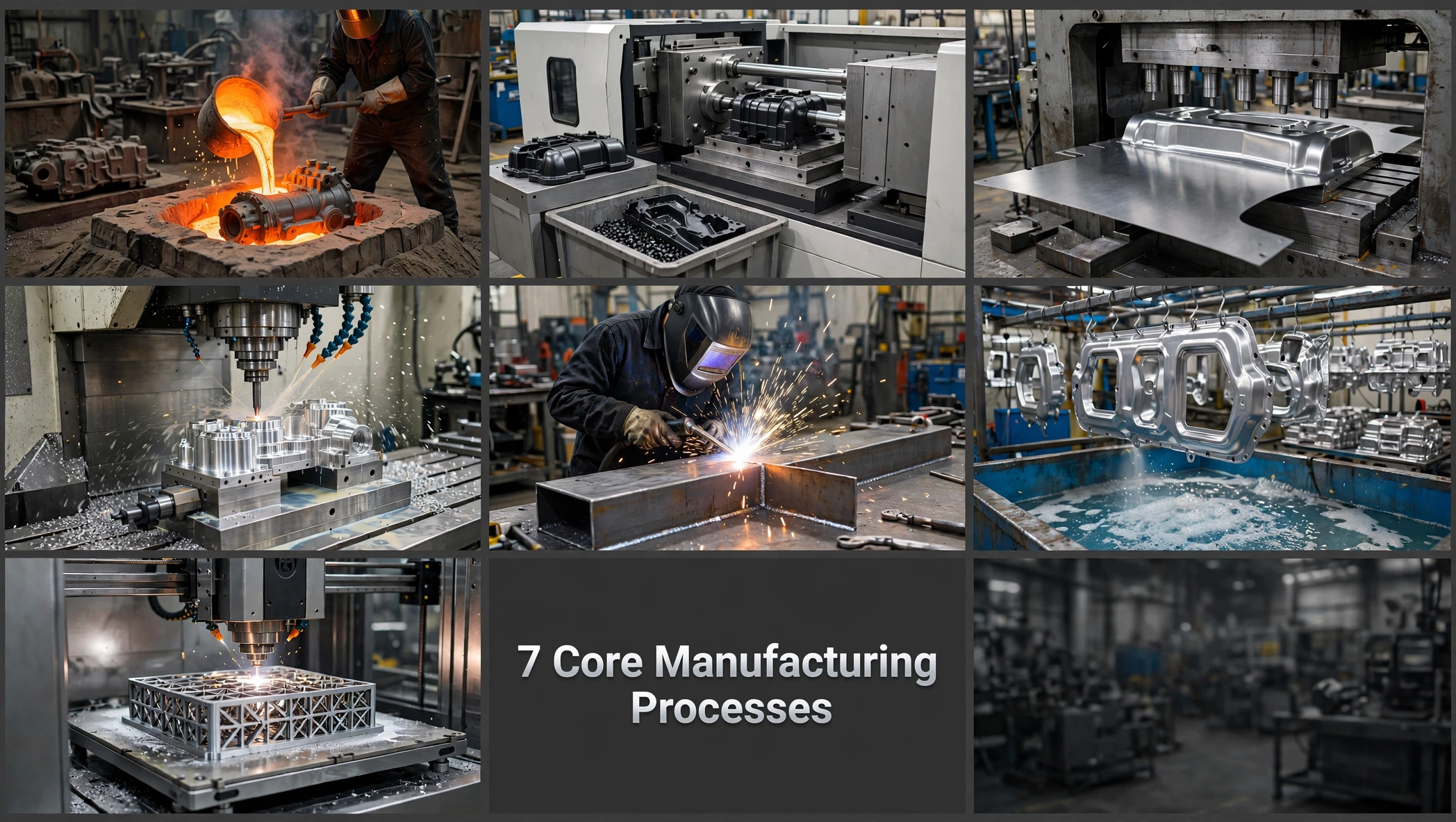
Every object you touch today – your phone, your car, the chair you’re sitting on, even the spoon in your kitchen – started life as raw material that was transformed into a finished shape.
through a manufacturing process. Whether you’re an engineering student preparing for exams, a curious learner, or a working professional brushing up on fundamentals, this guide breaks down the 7 core manufacturing processes in simple language, with practical, everyday examples.
Definition:
A manufacturing process is any method used to convert raw materials (metal, plastic, ceramic or composite) into a usable product, component, or part.
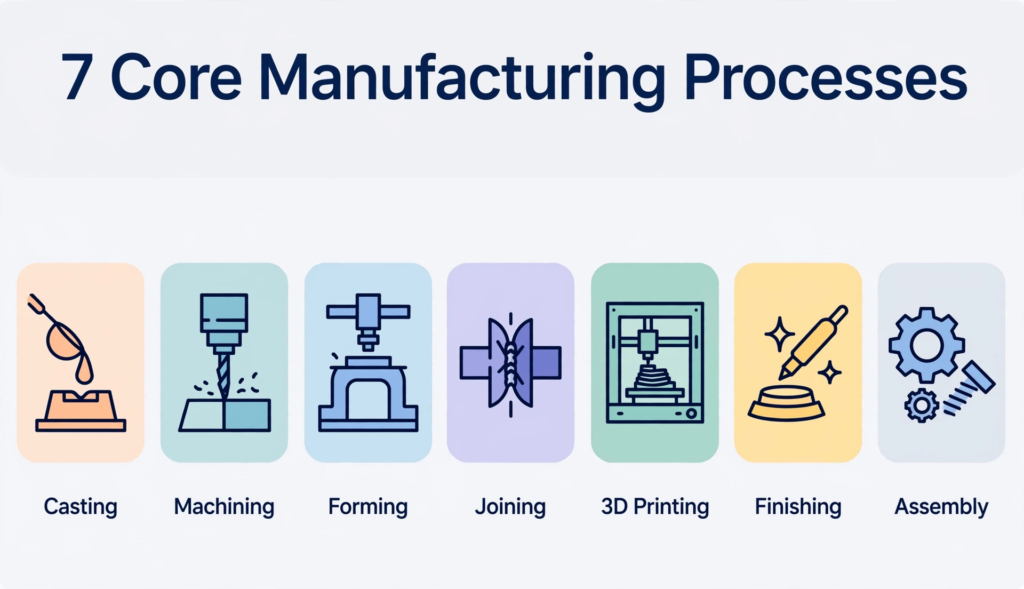
There are 7 manufacturing processes:
- Casting
- Molding
- Forming
- Machining
- Joining
- Surface Treatment
- Additive Manufacturing (3D Printing)
1. Casting Manufacturing Process.
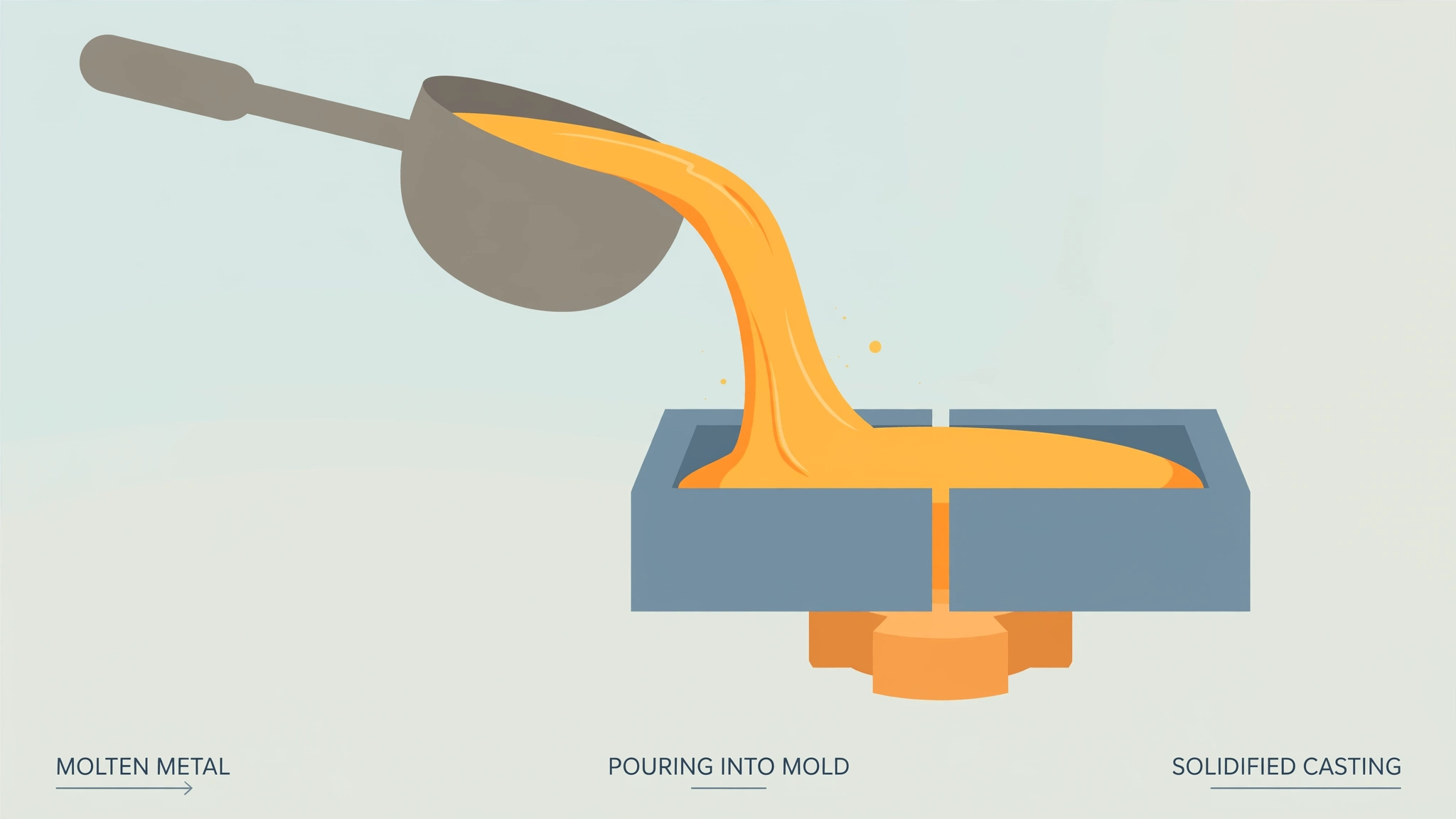
Casting is one of the oldest manufacturing processes in human history. indeed dating back over 6,000 years. It involves pouring molten (liquid) metal into a hollow cavity called a mould, letting it cool and further solidify it into the desired shape.
How it works:
- A pattern (replica of the final part) is used to create a mould cavity, usually in sand, ceramic, or metal.
- Then this pattern is developed by precision engineers.
- Later molten metal is poured into the cavity.
- After that the metal cools and solidifies.
- At last the mould is broken or opened, and the casting is removed and finished.
Common types:
Sand Casting: Low cost, used for large parts like engine blocks
Die Casting: high-precision, used for mass production of small aluminum/zinc parts
Investment Casting (Lost-Wax Casting): used for intricate, high-detail parts liketurbine blades and jewelry
Centrifugal Casting: used for pipes and cylindrical components
Real-World Examples:
- Automotive engine blocks (Ford, General Motors and Toyota) – Sand and die-casting.
- Turbine blade in jet engines (Rolls Royce, GE Aviation) – investment casting.
- Pipe Fittings & Manhole Cover – Sand casting, Common across India and China.
- Statues and sculptures – Investment casting.
The advantages of this manufacturing process are that complex shapes are possible and it is economical for large parts; also, it works with almost any metal.
Further, this process is limited, with the surface finish often needing secondary machining; porosity/defects can occur.
2. Molding
Molding is primarily used for plastics, rubber, and polymers, though metal injection molding also exists. Unlike casting, molding often uses pressure to force material into a mould. Molding is also spelt as ‘moulding’ in some regions
How it works:
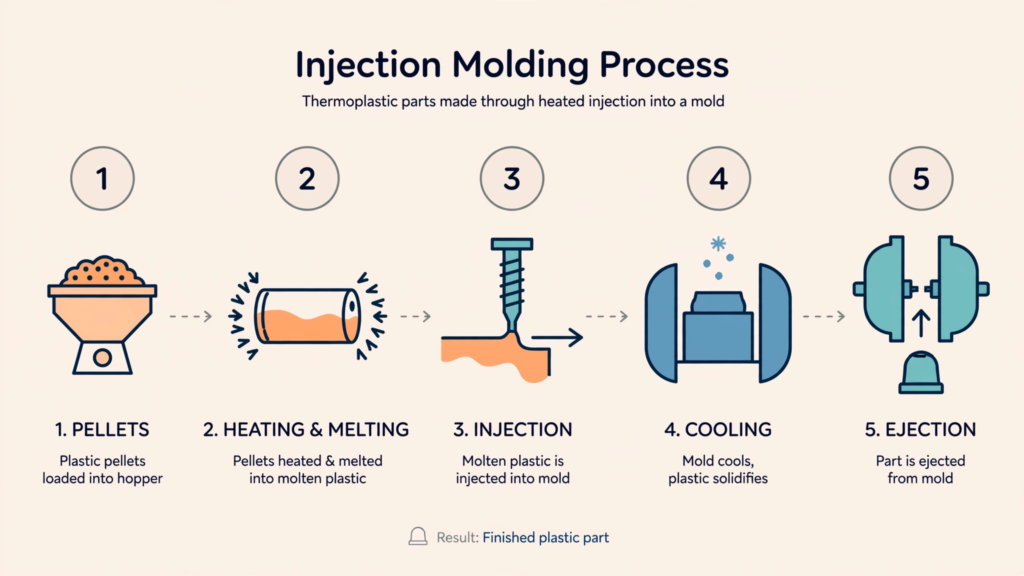
- At first, raw material (plastic pellets and rubber compound) is heated until it softens or melts.
- Then it is injected or pressed into a mould cavity under pressure.
- Later the material cools/cures and takes the mould’s shape.
- At last the part is ejected.
Common types:
Injection Molding: The most widely used plastic manufacturing process worldwide
Blow Molding: Used for hollow parts like bottles
Compression Molding: Used for rubber components like gaskets, tires
Rotational Molding: Used for large hollow parts like water tanks, kayaks
Real-World Examples:
- Plastic bottle caps and containers: Coca-Cola, Nestlé — injection molding
- Automotive dashboards and bumpers: BMW, Volkswagen, Hyundai— injection molding
- Car tyres: Michelin, Bridgestone, MRF in India — compression molding
- LEGO bricks: Precision injection molding
Advantages of this process are that it is excellent for mass production and high precision as well as minimal waste. Furthermore, limitations are that it requires high initial tooling/mould costs and is mainly suited to plastics and elastomers only.
3. Forming
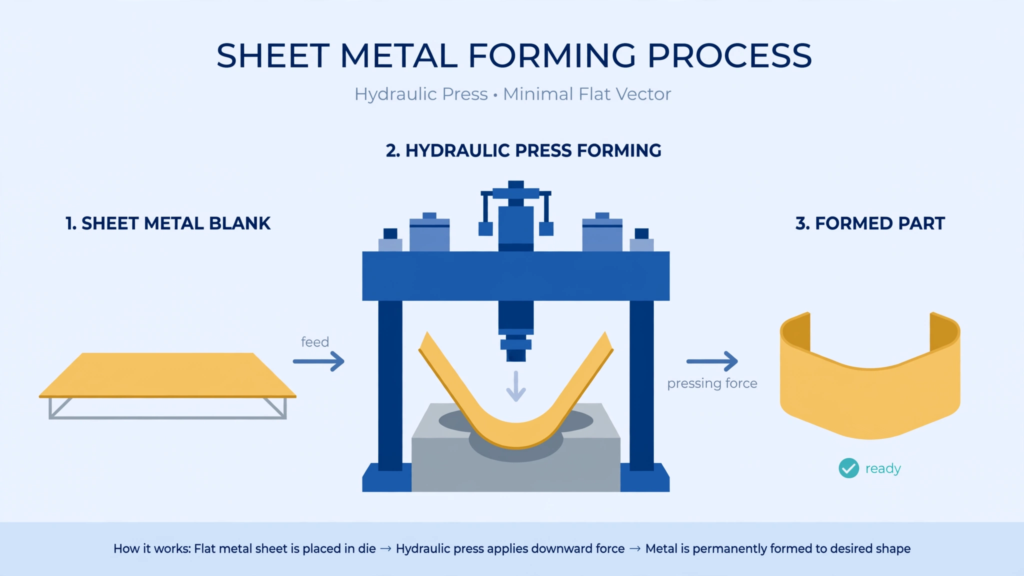
Forming is the manufacturing process that reshapes solid metal using mechanical force without removing material. Think of it as “pushing metal into shape” rather than melting or cutting it.
How it works:
In this manufacturing process, metal is subjected to compressive, tensile, or shear forces using dies and rollers, as well as presses, causing plastic deformation into the desired shape. Usually these metals are in sheet, bar, or billet form.
Common types:
Rolling: Passing metal between rollers to reduce thickness (used for sheets, rails, plates)
Forging: Hammering or pressing metal into shape (used for crankshafts and wrenches)
Extrusion: Pushing metal through a die to create long, uniform cross-sections (used for aluminum window frames, tubing)
Sheet Metal Forming / Stamping: Bending, stretching, or stamping thin metalsheets (used for car body panels)
Drawing: Pulling metal through a die to reduce diameter (used for wires and cables)
Real-World Examples:
- Car body panels: Toyota, Tesla, Volkswagen — stamping and sheet metal forming
- Aircraft landing gear and crankshafts: Boeing, Airbus — forging
- Aluminum extrusions for window frames and heat sinks: common in Europeanconstruction and electronics
- Steel rails for railways: Tata Steel, ArcelorMittal, Nippon Steel — rolling
Forming improves the strength of a component through favourable grain flow while minimizing material waste, making it a suitable process for producing high-strength parts. However, forming requires powerful equipment and is less suitable for manufacturing components with very complex geometries.
4. Machining
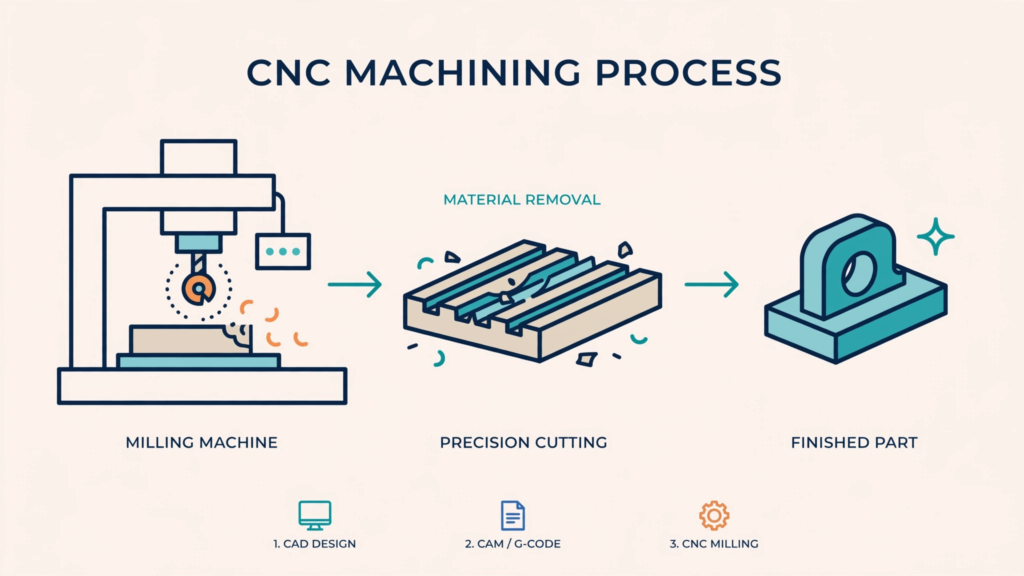
Machining is a subtractive manufacturing process in which material is deliberately removed from a solid workpiece using a cutting tool to produce the desired shape and precise dimensions.
How it works:
A rotating or moving cutting tool removes material from the workpiece layer by layer to achieve the desired shape as well as dimensions, with the process typically controlled by Computer Numerical Control (CNC) systems to ensure high accuracy and precision.
Common types:
Turning (on a lathe): Rotates the workpiece (on a lathe) against a fixed tool; used for shafts, bolts and cylindrical items.
Milling: Rotating cutter removes material from a stationary/moving workpiece; used for gears, brackets, etc.
Drilling: Creates round holes.
Grinding: It uses an abrasive wheel for fine finishing and tight tolerances.
CNC Machining: Computer-controlled precision machining used across nearly all modern industries.
Real-World Examples:
- Engine crankshafts and camshafts: CNC turning and milling.
- Aerospace structural components: Boeing, Airbus, HAL India — 5-axis CNC machining.
- Precision medical implants: Hip joints, dental implants — CNC milling and grinding.
- Consumer electronics housings: Apple’s aluminium unibody laptops — CNC milling.
Machining offers extremely high precision and excellent surface finish, making it suitable for processing almost any hard material. However, it generates material waste in the form of chips or scrap. Machining is generally slower and more expensive per part than forming processes for high-volume production.
5. Joining
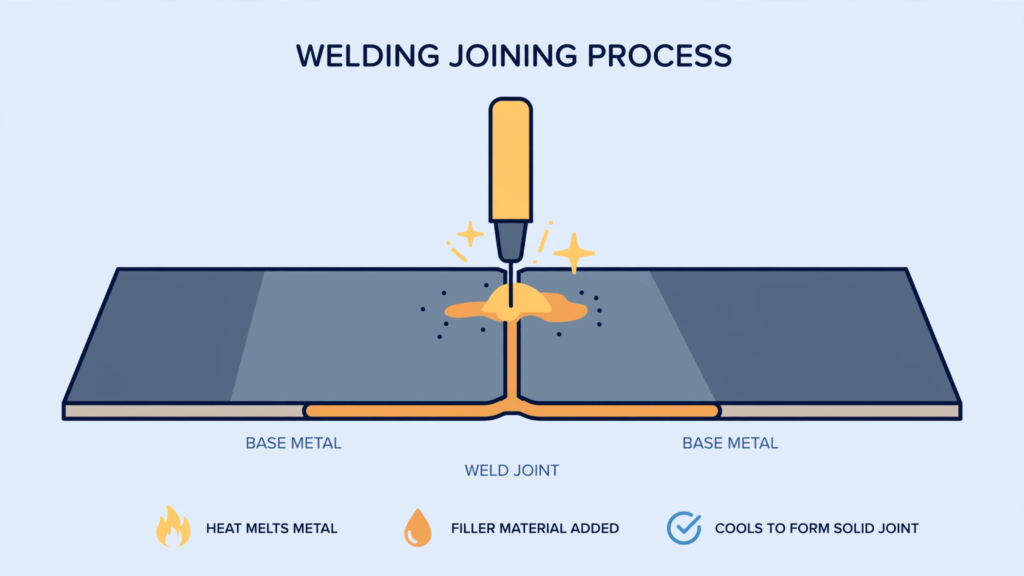
The joining process is the manufacturing process in which two or more separate components are combined into a single assembly, either permanently or temporarily.
How it works:
The joining process is used to connect two or more parts into a single, functional assembly. Depending on the application and material, components can be joined using heat, pressure, adhesives, or mechanical fasteners. Each method offers unique advantages in terms of strength, durability, cost, and ease of assembly, making it suitable for different manufacturing and engineering applications.
Common types:
Welding: Fuses metal parts using heat (arc welding, MIG, TIG, and laser welding).
Brazing & Soldering: Joins metals using a filler material at lower temperatures (common in electronics and plumbing).
Riveting & Bolting: Mechanical fastening, widely used in aircraft and structural steel.
Adhesive Bonding: Uses industrial adhesives, common in automotive and aerospace composites.
Real-World Examples:
- Ship hulls and structural steel frameworks: arc and MIG welding
- Aircraft fuselage panels: Boeing, Airbus planes – riveting and adhesive bonding
- Printed circuit board (PCB) components — soldering
- Bridges and steel structures (common across US, European, and Asian infrastructure projects) — welding and bolting
Advantages: Joining processes enable manufacturers to create complex assemblies by combining multiple simpler parts into a single functional product. They also offer flexibility, as joints can be permanent, such as those made by welding, or removable, such as those secured with bolts, making maintenance and repairs easier when required.
Limitations: Some joining methods, particularly welding, can introduce residual stresses and heat distortion that may affect the strength or dimensional accuracy of the final component. Additionally, the quality and reliability of the joint depend heavily on the operator’s skill, the chosen technique, and proper process control.
6. Surface Treatment
Surface treatment processes are used to enhance the outer surface of a manufactured part without altering its core shape or dimensions. These processes improve the component’s appearance, corrosion resistance, wear resistance, and surface adhesion, helping to increase its durability and overall performance.
How it works:
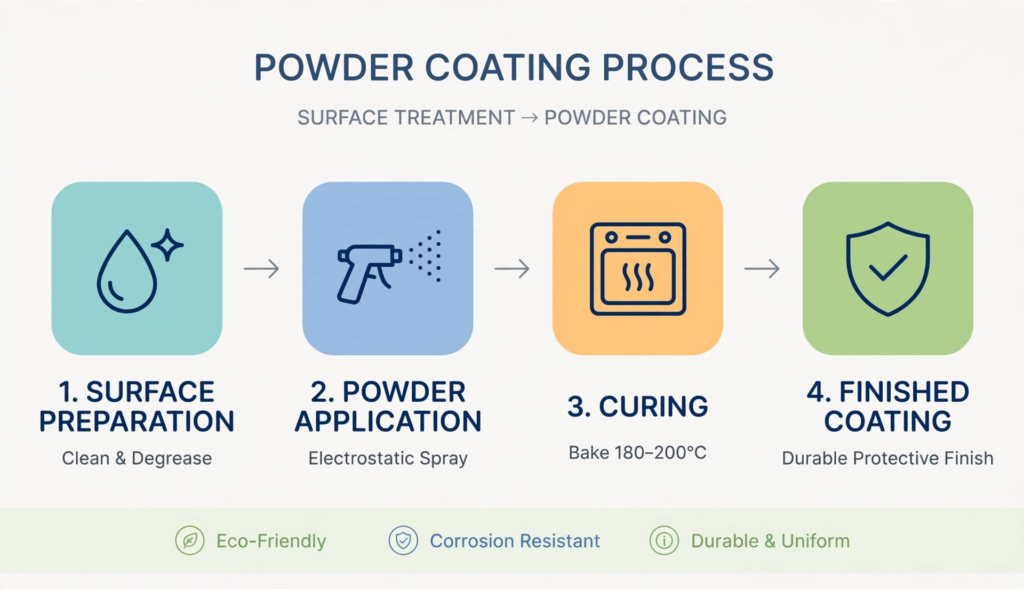
Surface treatment is carried out using chemical, electrochemical, or mechanical methods that either apply a protective or functional coating or modify the surface properties of the material. The choice of process depends on the material, operating environment, and desired performance characteristics. For an example of this manufacturing process, please refer to the below image of powder coating treatment.
Common types:
Electroplating: Deposits a thin metal layer (chrome, zinc, and gold) using electric current.
Anodizing: Forms a protective oxide layer, mainly on aluminium.
Powder Coating & Painting: Adds a durable, decorative protective layer.
Heat Treatment (annealing, quenching, tempering, and case hardening): alters hardness and strength.
Galvanizing: Zinc coating to prevent rust on steel.
Real-world examples:
- Chrome-plated car bumpers and bathroom fittings: Electroplating.
- Anodized aluminium smartphone bodies (Apple, Samsung): Anodizing.
- Galvanized steel roofing sheets and guardrails: Widely used in construction across Asia, Europe, and the USA.
- Hardened gears and automotive camshafts: Case hardening/heat treatment.
Advantages: Surface treatment processes significantly extend the service life of manufactured components by improving their resistance to corrosion, wear, and environmental damage. They also enhance the appearance of products by providing a smooth, decorative finish while improving surface properties such as adhesion for paints, coatings, and adhesives.
Limitations: Surface treatment processes add extra manufacturing steps, increasing both production time and overall cost. Additionally, certain methods, such as electroplating, use environmentally sensitive chemicals that require careful handling, waste treatment, and compliance with environmental regulations.
7. Additive Manufacturing (3D Printing)
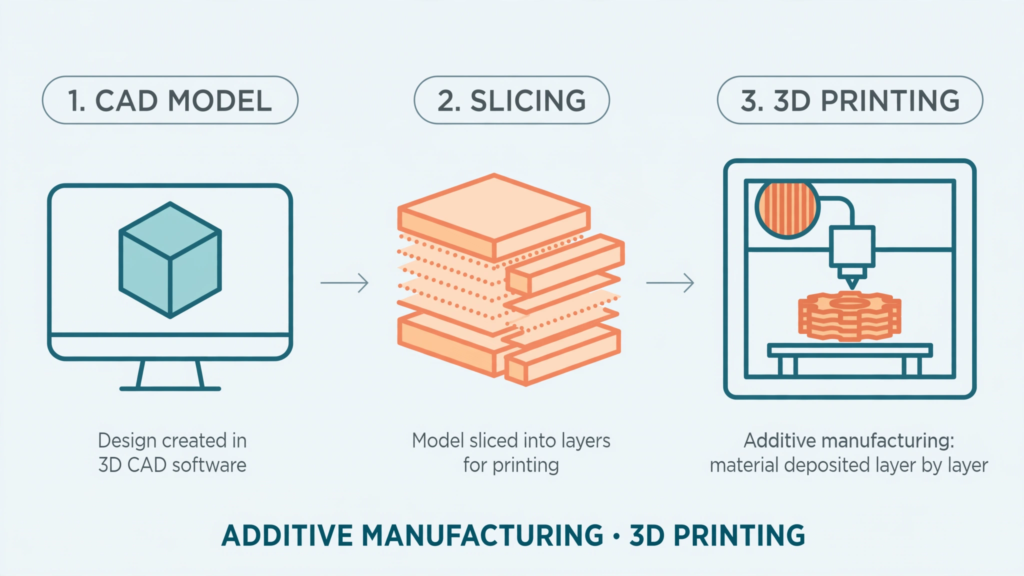
Additive manufacturing, commonly known as 3D printing, is a modern manufacturing process that creates parts by adding material layer by layer from a digital 3D model. Unlike traditional machining, which removes material from a solid workpiece, additive manufacturing builds components only where material is needed. This approach minimizes material waste, enables the production of complex geometries, and allows for rapid prototyping and customized part manufacturing.
How it works:
- At first a 3D CAD model is sliced into thin horizontal layers by software.
- Then a printer deposits, cures, or fuses material (plastic, metal powder, and resin) one layer at a time.
- Furthermore, layers bond together, gradually building the complete part.
Common types:
FDM (Fused Deposition Modeling): Creates parts by melting and extruding plastic filament layer by layer, then making it one of the most widely used and cost-effective 3D printing methods.
SLA (Stereolithography): Uses a laser or UV light to cure liquid resin into solid layers, further producing highly detailed parts with smooth surface finishes.
SLS (Selective Laser Sintering): Builds components by using a laser to fuse powdered materials, such as plastic or metal, into strong and functional parts.
DMLS/Metal 3D Printing: DMLS stands for ‘Direct Metal Laser Sintering.’ Also known as ‘metal 3D printing,’ it uses a high-powered laser to fuse fine metal powder, enabling the production of high-strength, complex components for industries such as aerospace, automotive, and medical manufacturing.
Real-world examples:
- Rocket engine components: SpaceX, Rocket Lab — metal 3D printing (DMLS)
- Custom prosthetics and dental aligners: healthcare industry worldwide—SLA/SLS printing
- Rapid prototyping in automotive design: BMW, Tata Motors, Hyundai — FDM and SLA
- Lightweight aerospace brackets: Airbus, GE Aviation — metal additive manufacturing
Advantages: Additive manufacturing eliminates the need for expensive tooling, making it ideal for producing complex geometries, customized components, and prototypes. It also reduces material waste by using only the required amount of material and enables faster product development through rapid prototyping.
Limitations: Additive manufacturing can be slower and less economical for large-scale mass production compared to traditional manufacturing methods. In addition, the available material choices and mechanical strength of printed parts may be limited depending on the specific 3D printing technology used.
Conclusion:
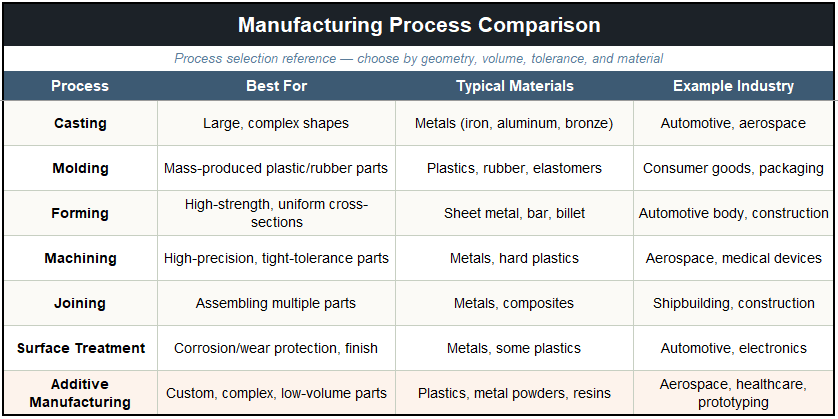
Understanding these seven manufacturing processes—casting, molding, forming, machining, joining, surface treatment, and additive manufacturing too—gives you a solid foundation in how virtually every engineered product is made.
You can refer to our blogs:
Stress-Strain Curve: A Guide to understand the Material Behaviour
SPM: Design Considerations in Special Purpose Machines
[…] Manufacturing processes […]
[…] for more manufacturing processes: Manufacturing Processes in Engineering […]