
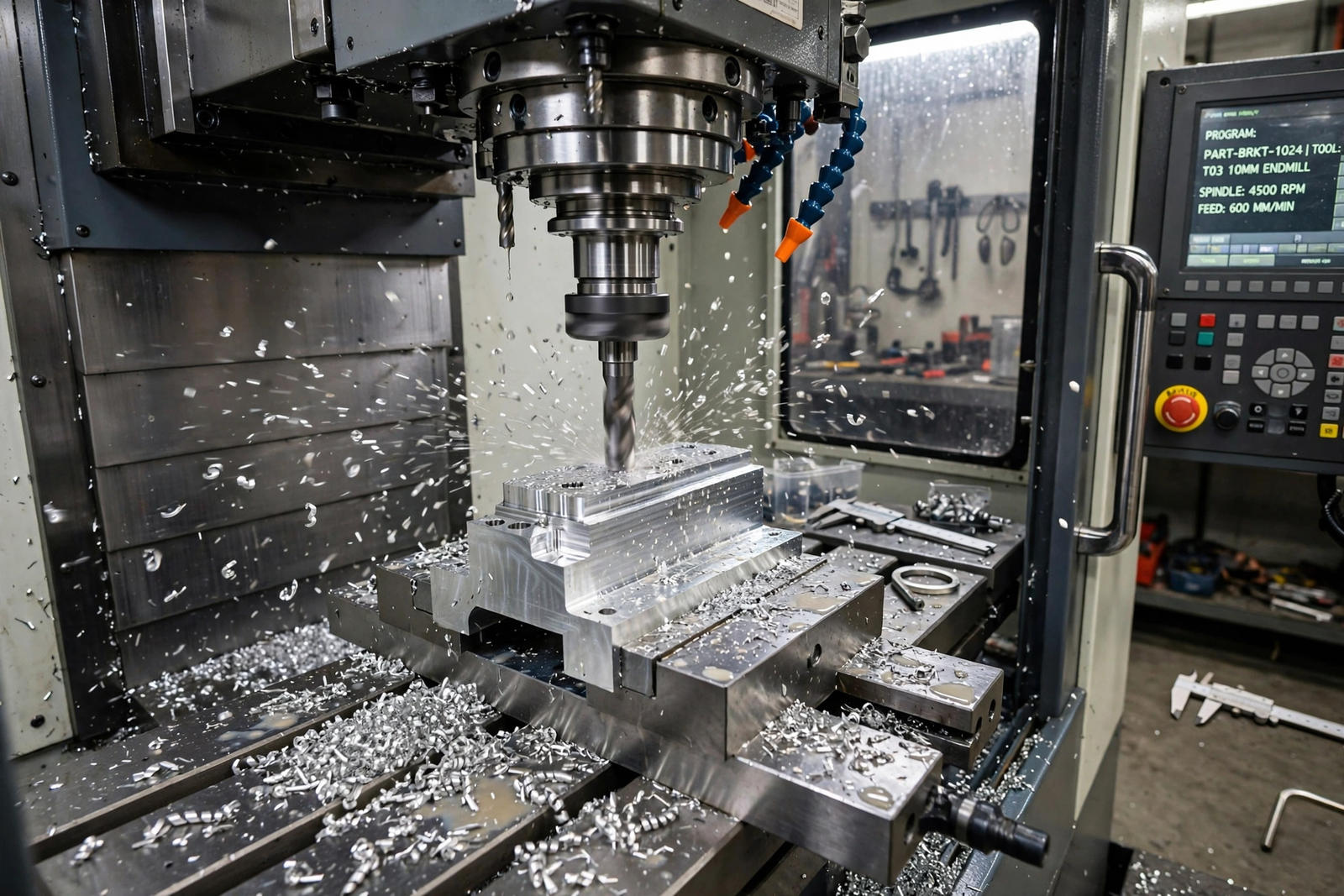
Hello Guys, Welcome to ElearnInsight. In our day-to-day life, we see many metallic parts around us. That metallic part was a solid metal block in the beginning. There are some machining processes too that shape the part. So, from aircraft brackets to phone frames, manufacturers rely on machining to turn raw stock into precise, functional components. Yet many students, engineers, and procurement teams still ask, What is a machining process, really, and which type fits a given job?
This guide answers that question in plain language. First, it defines the machining process. Then, it walks through every major conventional and advanced machining process, along with the machines used for each. Finally, it shows how professionals actually select a process on the shop floor. Whether you are a mechanical engineering student, a design engineer, or a buyer sourcing CNC machining services, this article gives you a practical, real-world reference.
What Is the Machining Process?
A machining process is a manufacturing method that removes material from a workpiece to create a desired shape and size, as well as surface finish. Unlike casting or forging, which form material into shape, machining cuts material away. A cutting tool, an abrasive wheel, an electric spark, or a chemical reagent removes the unwanted material layer by layer.
Engineers choose machining because it delivers tight tolerances and excellent surface finish. In addition, it works on almost every engineering material, including steel, aluminium, titanium, plastics, and composites. As a result, machining remains central to aerospace, automotive, medical device, and general manufacturing industries across the USA, Europe, Asia, and the Middle East.
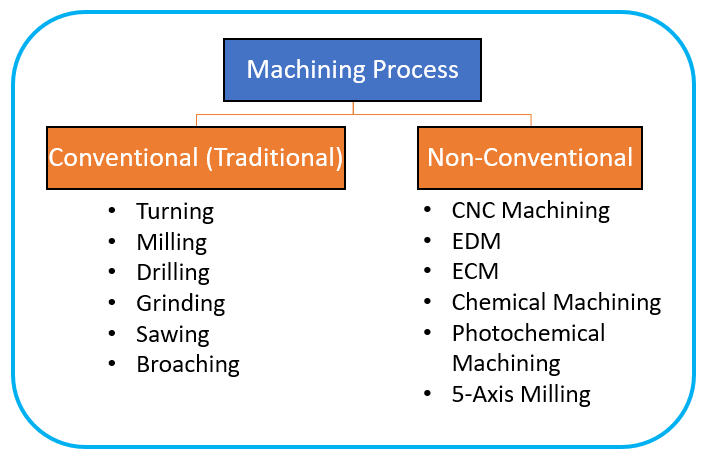
Broadly, engineers classify every machining process into two families:
- Conventional (traditional) machining process — turning, milling, drilling, grinding, sawing, and broaching.
- Non-conventional (advanced) machining processes — CNC machining, EDM, ECM, chemical machining, photochemical machining, and 5-axis milling.
Let’s explore each one in detail, along with the machines that perform them.
Different Types of Machining Processes
No single machining process is suitable for every manufacturing job. Each machining method has its own strengths and limitations. For example, one process may offer high speed, while another may provide better accuracy or surface finish. Some processes also work better with specific materials, such as metals, plastics, or hard alloys. Therefore, manufacturers must consider speed, accuracy, cost, material type, and required surface finish before selecting a machining process. Understanding these factors helps engineers and manufacturers choose the most suitable process for each application, reduce production costs, and achieve better product quality.
A. Conventional (Traditional) Machining Processes
Conventional machining processes use a hard cutting tool to physically shear material away from a workpiece. These methods are the oldest, the most widely available, and often the most economical for medium-to-large features.
1. Turning Machining Process
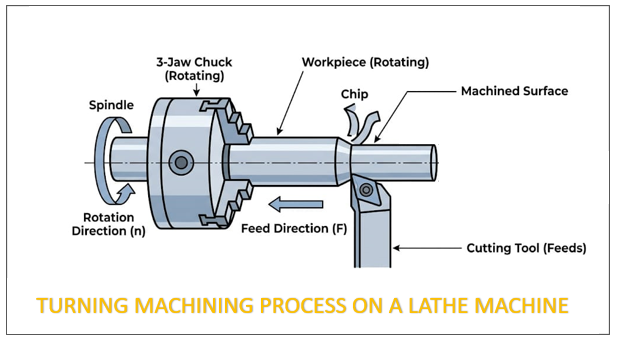
Turning rotates the workpiece against a stationary, single-point cutting tool. Consequently, it produces cylindrical shapes such as shafts, pins, and bushings efficiently.
Machine used: engine lathe machine, turret lathe machine, or CNC lathe.
Best for: Parts with a round geometry, machining the external and internal diameters, performing threads, and making tapers.
Turning remains one of the fastest ways to produce round, symmetrical parts. Moreover, modern CNC lathes automate the process, so operators can hold tolerances as tight as ±0.01 mm.
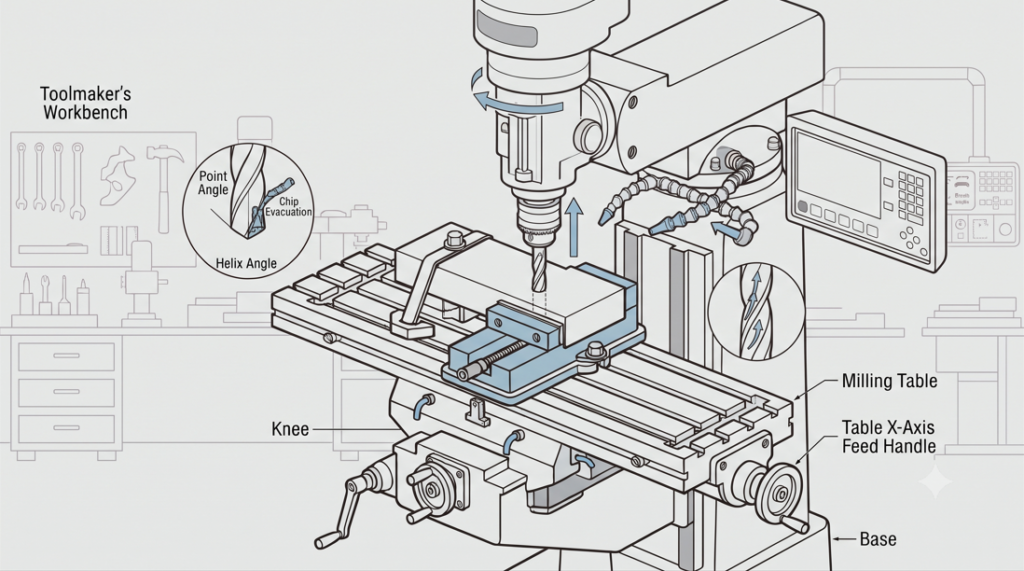
2. Milling Process
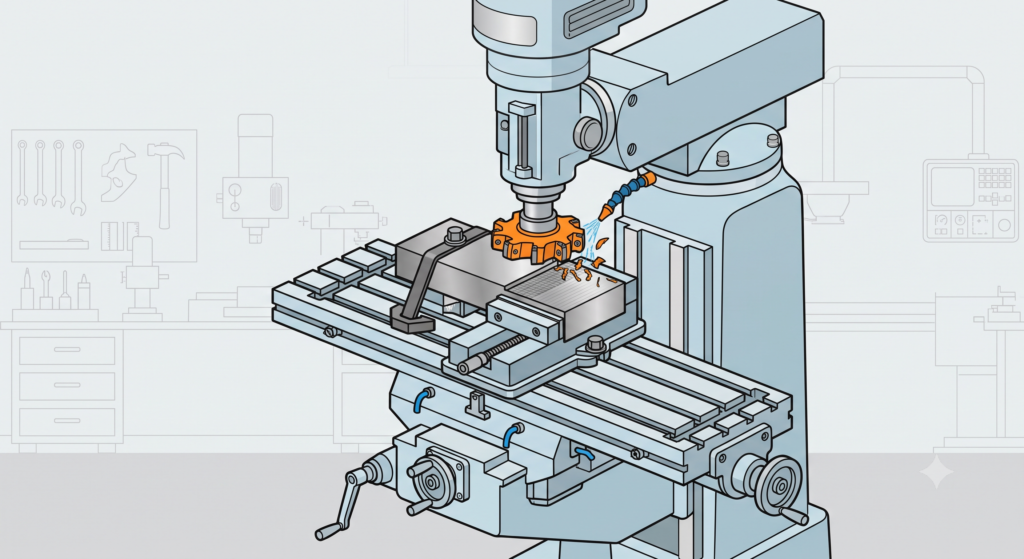
Milling uses a rotating multi-point cutter to remove material from a stationary or moving workpiece. Because the cutter can approach the part from multiple angles, milling produces flat surfaces, slots, pockets, and complex contours.
Machine used: vertical milling machine, horizontal milling machine, or CNC machining center.
Best for: Flat faces, slots, gear teeth, and prismatic parts.
Since milling cutters come in countless geometries, this process handles everything from rough facing to fine-detail contouring in a single setup.
3. Drilling Process
Drilling creates round holes using a rotating, multi-edge cutting tool called a drill bit. Although it seems simple, drilling accuracy directly affects downstream assembly quality.
Machine used: drill press, radial drilling machine, or CNC drilling center.
Best for: Through-holes, blind holes, and holes that will later be tapped or reamed.
4. Grinding Process
Grinding uses a rotating abrasive wheel to remove very small amounts of material. Therefore, it delivers the finest surface finish and tightest tolerances among conventional methods.
Machine used: surface grinder, cylindrical grinder, or centerless grinder.
Best for: Hardened components, final finishing passes, and precision bearing surfaces.
5. Sawing Process
Sawing separates raw stock into workable sizes using a toothed blade. Typically, it serves as the first step before other machining operations begin.
Machine used: Band saw, hacksaw, or circular saw.
Best for: Cutting bar stock, plate, and tubing to length.
6. Broaching Process
Broaching pushes or pulls a multi-tooth cutting tool through or across a workpiece in a single pass. Each successive tooth removes a bit more material, so the final tooth defines the finished shape.
Machine used: Vertical broaching machine or horizontal broaching machine.
Best for: Keyways, splines, and internal gear profiles that need high-volume repeatability.
B. Non-Conventional (Advanced) Machining Processes
When conventional cutting tools cannot handle a material’s hardness, a part’s fragility, or a feature’s complexity, engineers turn to non-conventional machining. These processes use electrical, chemical, or thermal energy instead of pure mechanical force.
1. CNC Machining Process
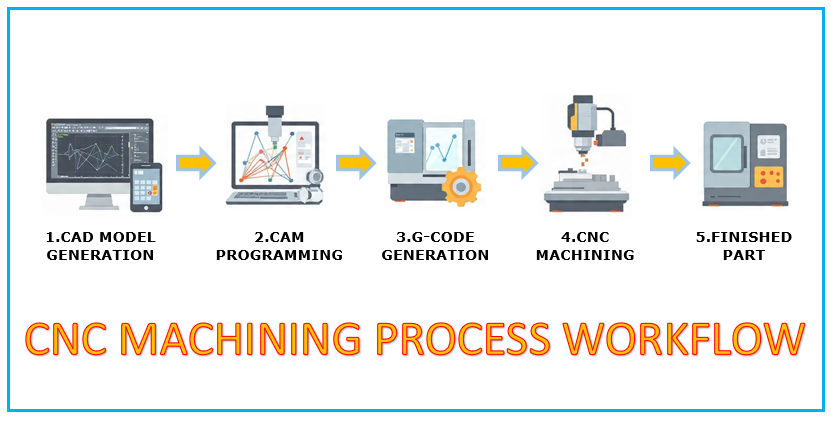
So, what is CNC machining? CNC stands for Computer Numerical Control. In short, the CNC machining process uses computer-programmed instructions to guide cutting tools automatically, instead of relying on a manual operator.
A CAD model becomes CAM toolpaths, and those toolpaths become G-code. Consequently, the CNC machine follows that code precisely, repeating the exact same motion on every part. Because of this repeatability, CNC machining services now dominate modern precision manufacturing.
Machine used: CNC mill, CNC lathe, CNC machining center.
Best for: High-precision, repeatable production runs across metals and plastics.
CNC machining also supports turning, milling, drilling, and grinding operations under one automated umbrella. That is why “cnc machining” and “machining” are often used interchangeably in modern industry, even though CNC is technically a control method rather than a standalone cutting process.
2. 5-Axis CNC Milling
Standard CNC mills move a tool along three linear axes (X, Y, Z). A 5-axis machine adds two rotational axes, so the cutting tool can approach a part from nearly any angle without repositioning it.
Machine used: 5-axis CNC machining center.
Best for: Aerospace turbine blades, impellers, and complex sculpted geometry.
Because the workpiece stays clamped throughout the job, 5-axis milling reduces setup errors and shortens cycle time on complex parts.
3. Electrical Discharge Machining (EDM) Process
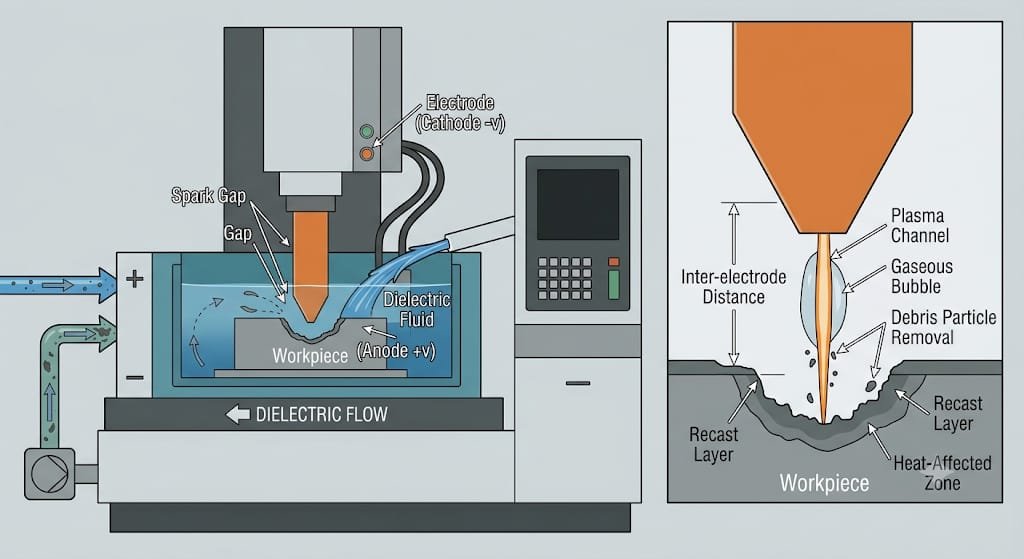
EDM machining removes material using controlled electrical sparks, rather than a physical cutting edge. An electrode and the workpiece sit in a dielectric fluid, separated by a tiny gap. When voltage builds, a spark jumps across that gap and erodes a microscopic amount of material.
Machine used: Wire EDM machine or sinker (die-sinking) EDM machine.
Best for: Hardened tool steel, intricate cavities, and features too fine for cutting tools.
Because the EDM machining process does not rely on mechanical force, it machines extremely hard materials without inducing cutting stress. As a result, mold makers and aerospace suppliers rely on it heavily.
4. Electrochemical Machining (ECM) Process
The electrochemical machining process removes material through controlled electrochemical dissolution. An electrolyte flows between a shaped electrode and the workpiece, while direct current dissolves metal ions from the workpiece surface.
Machine used: ECM machine with electrolyte pumping system.
Best for: Deburring and shaping hard, conductive materials without heat or mechanical stress.
Since ECM leaves no tool wear and no thermal damage, it suits turbine blades, surgical implants, and other high-value components.
5. Chemical Machining Process
The chemical machining process removes material through a controlled chemical etchant. Technicians mask the areas that must remain, then dip or spray the exposed surface with an acid or alkaline solution.
Machine used: Chemical etching tank or spray-etch system.
Best for: Large, thin sheet-metal parts and shallow, wide cavities.
6. Photochemical Machining Process
The photochemical machining process, sometimes called photo-etching, applies a photosensitive resist and a photographic mask before etching. Light exposure hardens the resist in the pattern of the final part, and the chemical bath then etches away everything else.
Machine used: Photoresist coating line, UV exposure unit, and etching conveyor.
Best for: Thin, burr-free, stress-free parts such as flex circuits, filters, and encoder discs.
The screw machining process runs on a specialized lathe called a screw machine, which produces small, high-volume, symmetrical parts automatically. Originally developed for screws and fasteners, the process now covers pins, bushings, and small precision shafts.
Machine used: Single-spindle or multi-spindle automatic screw machine (Swiss-type lathe).
Best for: High-volume production of small, precise, round parts.
CNC Machining Services and Industry Applications
Modern manufacturers rarely buy a single machine. Instead, they buy CNC machining services from a supplier who already owns the right equipment, tooling, and quality systems. This section covers how different industries apply CNC machining.
Precision CNC Machining
Precision machining, and specifically precision CNC machining, targets tolerances tighter than ±0.05 mm. Medical device makers, semiconductor equipment builders, and instrumentation companies depend on this level of accuracy every day.
Precision CNC machining combines rigid machine tools, temperature-controlled shop floors, and in-process metrology. Together, these factors keep dimensional variation to a minimum across thousands of parts.
Aerospace CNC Machining
Aerospace CNC machining produces structural brackets, engine components, and landing-gear parts from titanium, Inconel, and aerospace-grade aluminum. Because flight safety depends on every part, aerospace CNC machining follows strict certifications, such as AS9100.
In addition, 5-axis milling and EDM machining often work together on aerospace components, since turbine geometry combines complex curves with extremely hard alloys.
CNC Machining for the Transportation Industry
CNC machining for the transportation industry covers automotive, rail, and marine components. Engine blocks, gearboxes, suspension parts, and EV battery housings all pass through CNC machining centers before final assembly.
As electric vehicles scale up worldwide, transportation manufacturers increasingly request lightweight aluminum and composite machining, alongside traditional steel parts.
Custom Machining Services
Custom machining services produce low-volume or one-off parts to a customer’s exact specification. Unlike mass production, custom machining prioritizes flexibility. A shop offering custom machining services typically supports rapid prototyping, reverse engineering, and short-run manufacturing for R&D teams.
What Is Gorilla Machining?
Gorilla machining is shop-floor slang for aggressive, high-material-removal-rate CNC machining, typically performed on large aluminum blocks. Rather than taking many light passes, gantry machining takes deep, fast cuts to remove bulk material quickly before finishing passes refine the final shape.
Aerospace and mold-making shops use gantry machining to cut cycle time dramatically on large structural components.
Common Machining Tools and Equipment
A wide range of machining tools supports every process described above. The most common include the following:
- Cutting tools: turning inserts, end mills, drill bits, reamers, and taps.
- Workholding tools: chucks, vises, collets, and fixtures.
- Measuring tools: calipers, micrometers, gauges, and coordinate measuring machines (CMM).
- Abrasive tools: grinding wheels and honing stones.
- Advanced tooling: EDM electrodes, ECM cathodes, and photochemical masks.
Choosing the right machining tools matters just as much as choosing the right process. After all, even a perfect process selection fails if the tool geometry does not match the material.
How to Select the Right Machining Process
Selecting the correct machining process is a real-world engineering decision, not a guess. Consider these factors in order:
- Material hardness. Soft metals suit conventional cutting. Besides, hardened tool steel usually needs EDM or grinding.
- Part geometry. Generally simple round parts favor turning or screw machining. While complex 3D geometry favors 5-axis CNC milling.
- Tolerance requirements. Standard tolerances suit conventional machining. Tolerances under ±0.02 mm push toward precision CNC machining or grinding.
- Production volume. Low volume favors custom machining services. High volume favors CNC automation or screw machining.
- Surface finish needs. Mirror finishes usually require grinding or EDM as a final step.
- Material conductivity. EDM and ECM only work on electrically conductive materials.
- Part thickness. Thin, delicate sheet parts often suit chemical or photochemical machining, since these methods avoid mechanical stress entirely.
- Budget and lead time. Conventional machining is typically cheaper for simple parts. Advanced processes cost more but unlock geometry that conventional tools cannot cut.
Following this checklist, in order, prevents costly redesigns and rejected parts. Furthermore, experienced process engineers revisit this list at every design revision, since a small geometry change can shift the ideal process entirely.
Conclusion
The machining process you choose shapes cost, lead time, and also part performance. Conventional methods—turning, milling, drilling, grinding, sawing, and broaching—remain the workhorses of general manufacturing. Meanwhile, non-conventional processes like CNC machining, EDM, ECM, chemical machining, and photochemical machining unlock geometry and materials that traditional tools simply cannot reach.
To know about more manufacturing processes, you can refer to our blog.
Manufacturing Processes in Engineering