
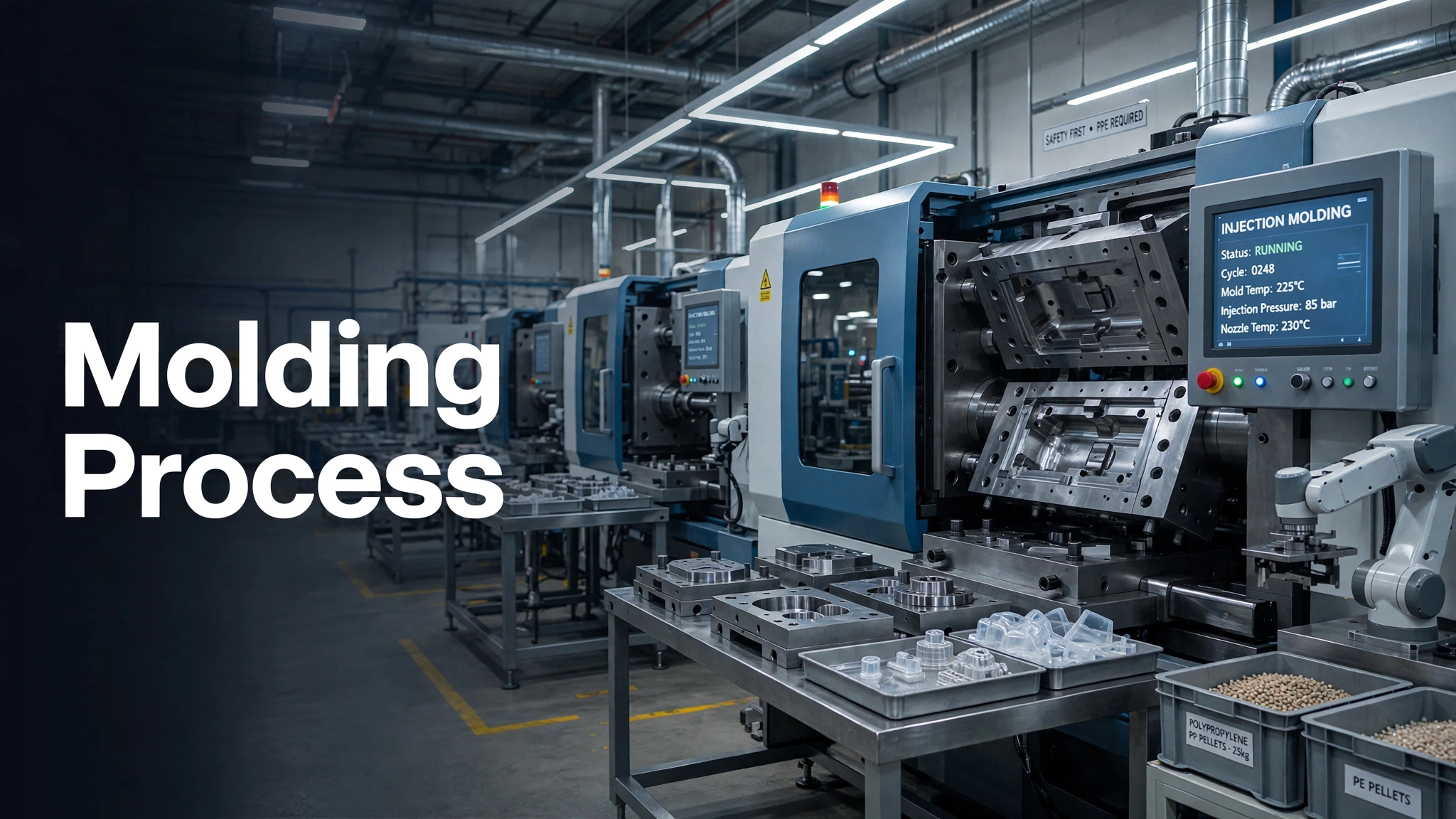
Hello folks, welcome back. Let’s explore one interesting manufacturing process, the molding process. In everyday life, we see manufacturers produce millions of parts that power industries and support everyday life. From car bumpers and water bottles to medical syringes and electronic housings, many of these products are made using one of the world’s most efficient manufacturing methods: molding. The molding manufacturing process transforms raw materials into precise, durable, and highly repeatable components. This process is great at its speed, accuracy, and cost-effectiveness. This makes it a preferred choice for mass production across industries such as automotive, healthcare, consumer goods, and packaging.
In this guide, you’ll learn how the molding process works step by step, explore its four primary types—injection molding, blow molding, compression molding, and rotational molding—and discover where each method is used. Whether you’re a student, engineer, product designer, or manufacturing professional, this guide will help you understand the fundamentals of modern molding technology.
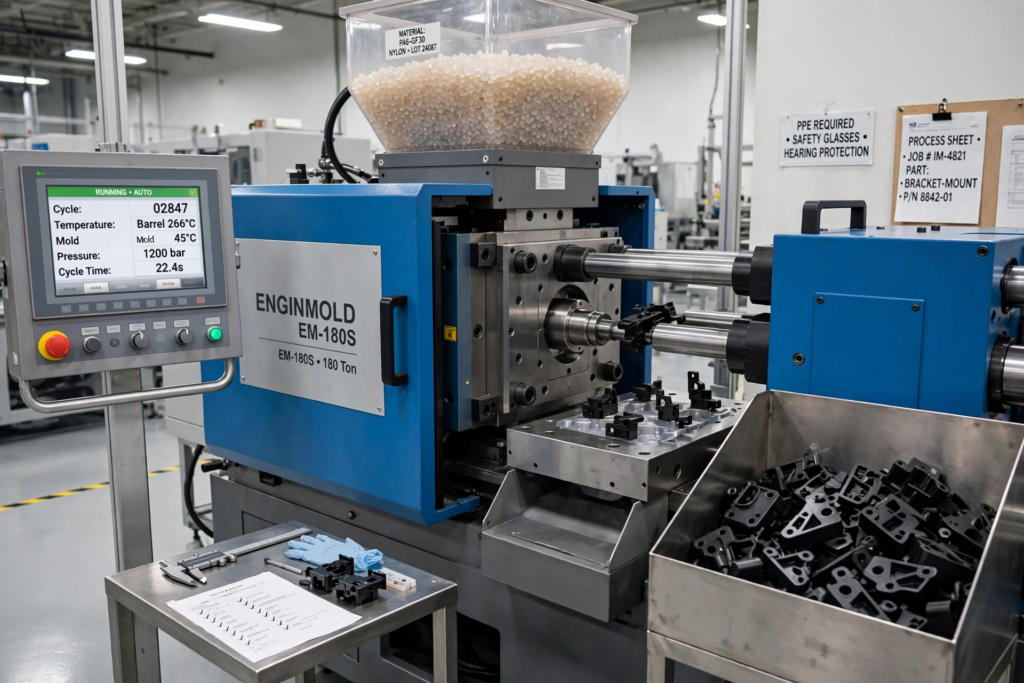
What is molding in manufacturing?
The molding process is a manufacturing method that shapes raw material inside a mold. The mold contains the exact geometry of the final product. First, manufacturers heat the raw material. Next, they inject, pour, compress, or spread it into the mold cavity. The material then cools and solidifies. Finally, workers remove the finished part from the mold. The molding process works with plastics, metals, ceramics, and rubber. However, plastic molding dominates modern manufacturing because it offers high production speed, excellent dimensional accuracy, and a low cost per part.
Moreover, the molding process is ideal for high-volume production. A single mold can produce thousands or even millions of identical parts with consistent quality. As a result, industries such as automotive, packaging, medical devices, consumer goods, and electronics rely on molding to manufacture durable and precise components efficiently.
How does the molding process work?
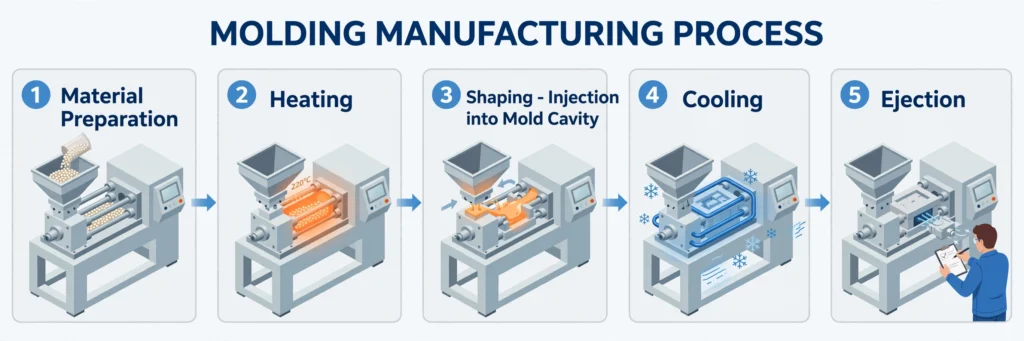
Every molding process follows the same basic workflow. Although the equipment varies, the core manufacturing steps remain the same.
1. Material Preparation: First, manufacturers select the appropriate raw material based on the product requirements. The material usually comes in the form of plastic pellets, powder, granules, or liquid resin.
2. Heating: Next, the molding machine heats the raw material until it becomes soft or fully molten. The required temperature depends on the material type and molding method.
3. Shaping: The softened material then enters the mold cavity. Depending on the process, injection pressure, compression force, gravity, or rotational motion shapes the material into the desired form.
4. Cooling: After shaping, the material cools inside the mold. As it loses heat, it solidifies and takes the exact shape of the mold cavity.
5. Ejection and Finishing: Finally, the machine ejects the finished part from the mold. Workers or automated systems remove excess material, also known as flash or sprue, to achieve the required finish.
This production cycle repeats for every part. Moreover, modern automated molding machines complete each cycle within seconds or minutes, depending on the molding process, material, and component size. As a result, manufacturers achieve high production rates with consistent quality.
Types of Molding Process
Manufacturers choose a molding process based on the part size, shape, material, production volume, and manufacturing cost. Each molding method offers unique advantages and suits specific applications. Therefore, selecting the right process improves product quality, production efficiency, and overall cost-effectiveness.
Let’s explore the four major types of molding processes.
1. Injection Molding
Injection molding is the most widely used molding process in modern manufacturing. It produces small to medium-sized plastic parts with high precision, excellent surface finish, and consistent quality. Therefore, manufacturers prefer this process for high-volume production.
How Injection Molding Works
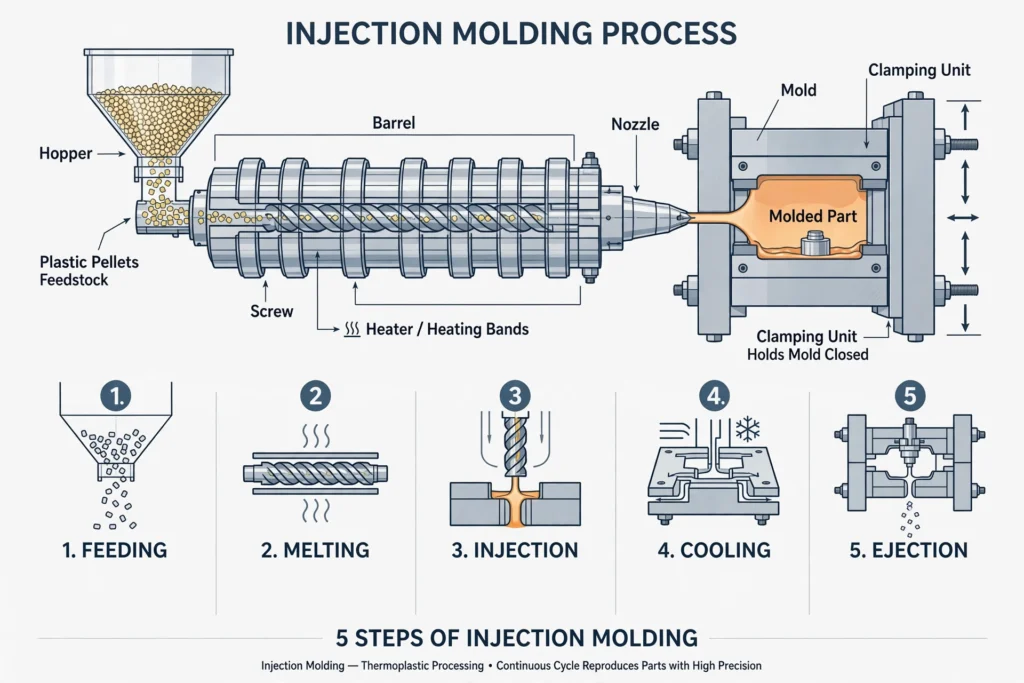
First, manufacturers feed plastic pellets into a heated barrel. A rotating screw melts the pellets and moves the molten plastic forward. Next, the screw injects the molten plastic into a closed mold cavity under high pressure. The material fills every corner of the mold and forms the desired shape. Afterward, the plastic cools and solidifies inside the mold. Finally, the mold opens, and the machine ejects the finished part.
Key Features of Injection Molding Systems
- High production speed
- Excellent dimensional accuracy
- Produces complex and detailed geometries
- Consistent part quality with minimal variation
- Low labor cost per unit in mass production
- Suitable for fully automated manufacturing
Common Applications of Injection Molding
Injection molding manufactures a wide range of plastic products. For example, it produces bottle caps, phone housings, automotive dashboards, electrical connectors, consumer goods, and medical syringes. As a result, industries such as automotive, medical, electronics, packaging, and consumer products rely on this process for fast, accurate, and cost-effective mass production.
Injection molding prototyping is one of the most valuable applications of the injection molding system because it allows manufacturers to validate product designs before full-scale production. Using prototype injection molds and prototype injection mould techniques, companies can quickly evaluate part performance, fit, and functionality while reducing development risks. Moreover, prototype plastic moulding supports rapid design improvements and shortens product development cycles. A rapid injection molding process enables manufacturers to produce high-quality prototype parts in days instead of weeks, making it ideal for automotive, medical, electronics, and consumer products. In some cases, compression molding services are also used for specific materials, but injection molding remains the preferred choice for precision plastic prototypes. In addition, small part injection molding delivers excellent dimensional accuracy for miniature components, while injection mold prototyping helps engineers identify design issues early, reducing production costs and accelerating time to market.
2. Blow Molding
Blow molding is a plastic molding process used to manufacture hollow plastic parts. It is ideal for producing lightweight products with uniform wall thickness. Therefore, manufacturers widely use this process for high-volume packaging applications.
How Blow Molding Works
First, the machine heats plastic until it becomes soft and forms a hollow tube called a parison. Next, the parison hangs between the two halves of an open mold. The mold then closes around it. After that, compressed air inflates the parison and pushes the molten plastic against the mold walls. The plastic cools and solidifies inside the mold. Finally, the mold opens, and the machine ejects the finished hollow part.
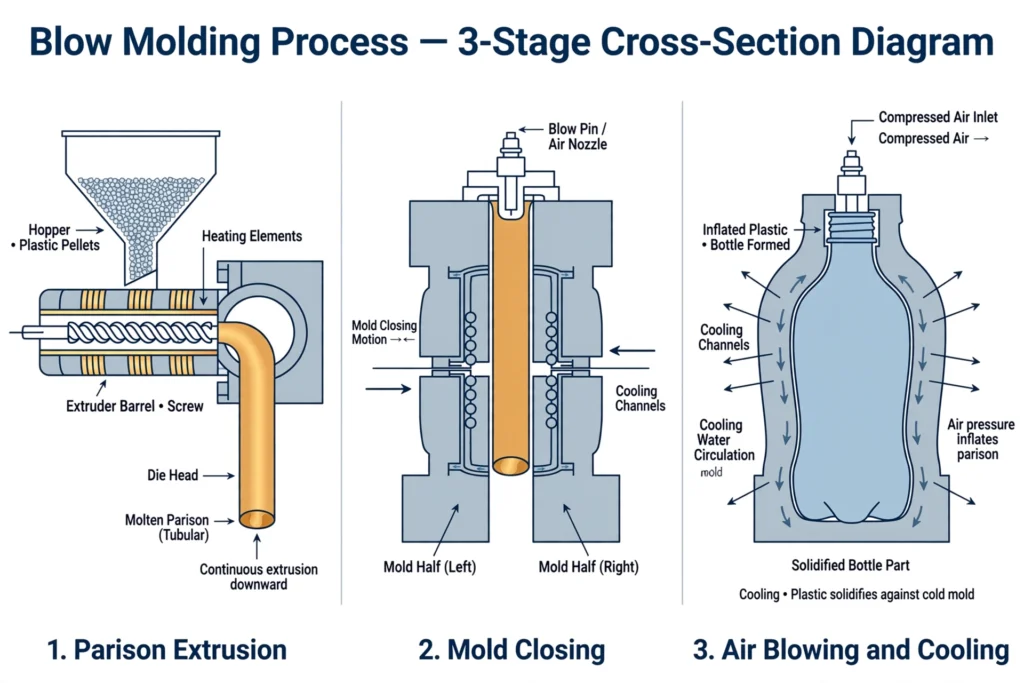
Key Features of Blow Molding
- Ideal for hollow and lightweight plastic parts
- Low material waste
- Fast production cycles
- Uniform wall thickness
- Cost-effective for high-volume manufacturing
- Suitable for automated production
Common Applications of Blow Molding
Blow molding produces a variety of hollow plastic products. It makes water bottles, beverage containers, shampoo bottles, fuel tanks, detergent containers, and industrial drums, for example. This means that industries such as packaging, food and beverage, automotive, and consumer goods depend on blow molding for fast, efficient, and economical production.
3. Compression Molding
Compression molding is a molding process that shapes material using heat and pressure inside a heated mold. It is commonly used for thermosetting plastics, rubber, and composite materials. Therefore, manufacturers choose this process for producing strong and durable components.
How Compression Molding works
First, workers deposit a charge of a pre-measured amount of material in a heated mold cavity. Then the mold closes and high pressure is applied. The material is filled in the whole cavity under the heat and pressure and takes the desired shape. The material cures in a solid state in the mold. Finally, the mold opens, and the finished part is removed. Finishing. Excess material, known as flash, is trimmed.
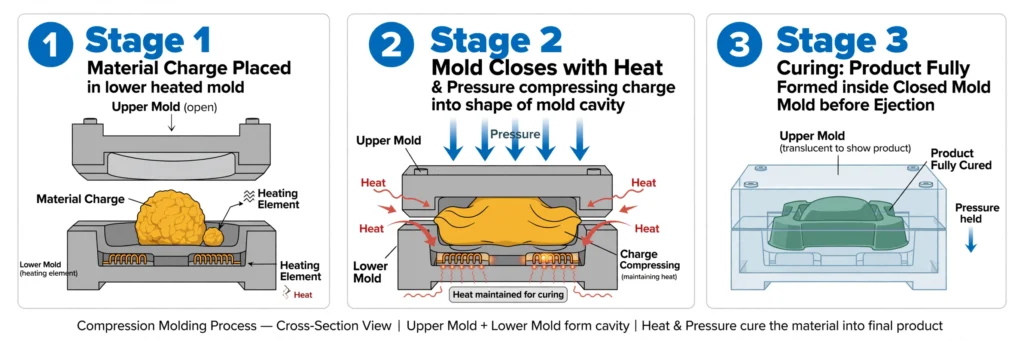
Key Features of Compression Molding
- Ideal for large, flat, and thick components
- Suitable for thermoset plastics, rubber, and composite materials
- Lower tooling cost than injection molding
- Produces strong, durable, and low-stress parts
- Excellent mechanical strength and dimensional stability
- Cost-effective for medium- to high-volume production
Common Applications of Compression Molding
Compression molding produces a number of industrial products. However, it produces automotive body panels, electrical insulators, rubber gaskets, appliance components, and composite structural parts, for example. Therefore, this process is used in industries such as automotive, electrical, aerospace, and construction to produce high-strength components with very good durability.
4. Rotational Molding
Rotational molding, also known as rotomolding, is a plastic molding process used to produce large, hollow, and seamless plastic parts. It is best for products that require uniform wall thickness and high durability. Therefore, manufacturers often choose this process for large components produced in low- to medium-volume batches.
How Rotational Molding Works
Workers first poured powdered plastic into a hollow mold. Next, the mold spins on two axes simultaneously inside a heated oven. The mold turns, melting the plastic so that it covers the inside walls evenly. Then, the mold keeps rotating during the cooling phase to ensure a uniform wall thickness and to avoid the material sagging. Finally, the mold opens, and the machine takes the finished seamless hollow part out.
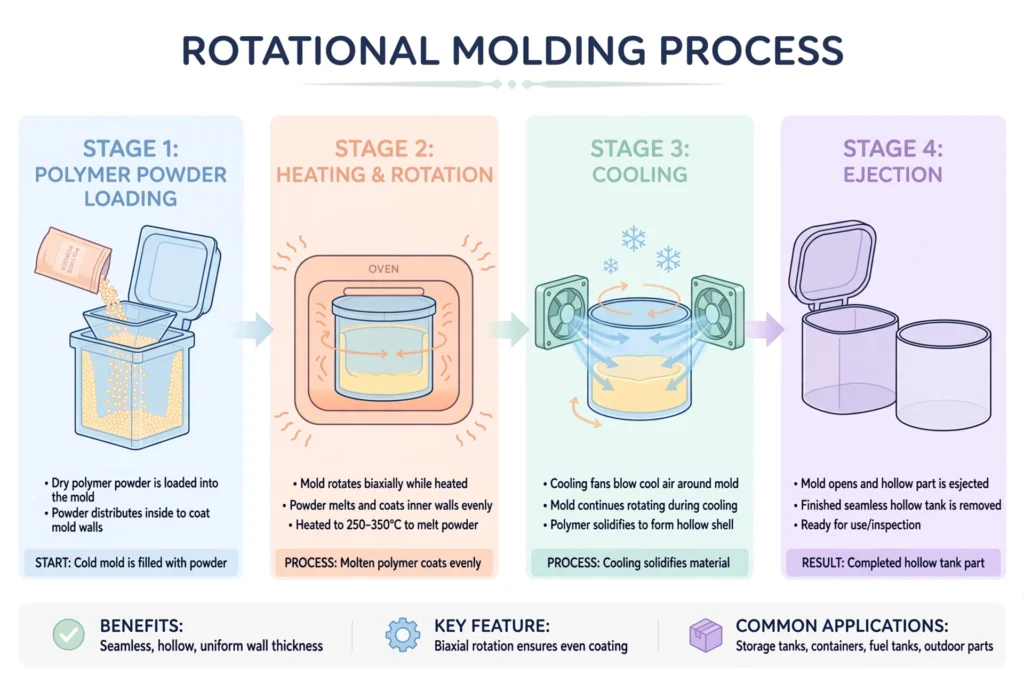
Key Features of Rotational Molding Process
- Produces large, hollow, and seamless parts
- Low tooling cost compared to injection molding
- Uniform wall thickness throughout the product
- Minimal material stress and warping
- Excellent impact resistance and durability
- Suitable for complex hollow shapes
Common Applications of Rotational Molding Process
Rotational molding is used to make a wide range of large plastic products. It manufactures water storage tanks, chemical tanks, playground equipment, kayaks, coolers, road barriers, and waste bins. This process is used in many industries such as construction, agriculture, transportation, marine, and recreation to make lightweight, durable, and corrosion-resistant components.
Molding Types Comparison Table
| Molding Type | Best For | Material Form | Typical Products |
| Injection Molding | Small, precise parts | Pellets | Caps, housings, medical parts |
| Blow Molding | Hollow parts | Softened tube (parison) | Bottles, tanks, containers |
| Compression Molding | Flat, thick parts | Pre-measured charge | Gaskets, insulators, panels |
| Rotational Molding | Large hollow parts | Powder | Tanks, kayaks, barriers |
This comparison table provides a quick overview of each molding process. As a result, engineers, students, and product designers can easily compare the available methods and select the most suitable process for their manufacturing project.
How to Choose the Right Molding Process
Selecting the right molding process depends on several important factors. By evaluating the product requirements, manufacturers can improve production efficiency, reduce costs, and achieve the desired product quality.
- Part Size: First, consider the size and shape of the component. Rotational molding is ideal for large, hollow parts, while injection molding is better for small, precise, and complex components.
- Production Volume: Next, determine the expected production volume. Injection molding is the best choice for high-volume manufacturing because of its fast cycle times. In contrast, rotational molding and compression molding are more suitable for low- to medium-volume production.
- Material Type: The material also plays a key role. Thermosetting plastics and rubber are commonly processed using compression molding. However, thermoplastics are well suited for injection molding and blow molding.
- Budget: Finally, compare the manufacturing budget. Rotational molding requires lower tooling costs, making it a good option for smaller production runs. On the other hand, injection molding involves a higher initial tooling investment but significantly reduces the cost per part in large-scale production.
Manufacturers should evaluate these factors before selecting a molding process. The right choice reduces costs, improves efficiency, and ensures consistent product quality. However, the wrong choice can increase costs and delay production.
Applications of The Molding Manufacturing Process
The molding process is a major part of modern manufacturing and supports a wide range of industries around the world.
- Automotive: Bumpers, dashboards, fuel tanks, and interior trim components.
- Packaging: Bottles, containers, caps, and closures.
- Medical: Syringes, IV components, surgical trays, and medical devices.
- Construction: Pipes, panels, fittings, and electrical insulators.
- Consumer Goods: Toys, furniture, storage bins, and household products.
Moreover, Asia is the dominant region in the global injection molding production, supported by the strong automotive and electronics industries. Meanwhile, the USA and Europe excel in high-precision molding for medical, aerospace, and industrial applications. Moreover, the demand for molded products in the Middle East and Africa is rising due to the expansion of the construction and packaging industries.
Future Trends in Molding Manufacturing
The molding process continues to evolve with new technologies. Today, manufacturers use smart sensors to monitor mold temperature and pressure in real time. As a result, they reduce defects, improve quality, and minimize material waste. Moreover, manufacturers are adopting recycled plastics and biodegradable polymers to support sustainable manufacturing and meet stricter environmental regulations.
In addition, 3D-printed molds are reducing tooling time and development costs. Therefore, manufacturers can prototype, test, and launch new products faster than ever before.
Conclusion
The molding process is one of the most important manufacturing methods used today. It produces high-quality parts with speed, precision, and consistency. Whether you choose injection, blow, compression, or rotational molding, each process offers unique advantages for different applications.
Understanding these molding methods helps engineers, students, and manufacturers select the right process for their projects. As a result, they can reduce costs, improve production efficiency, and manufacture reliable products with confidence.
Please refer to our other blogs:
for more manufacturing processes: Manufacturing Processes in Engineering
For the casting process: Casting Process In Manufacturing
Disclaimer: Some visuals in this article have been created using AI-generated imagery to help explain manufacturing concepts. These images are for illustrative purposes only and should not be considered exact representations of equipment, products, or industrial processes. Thank you.