

Every accountant, every finance student, and every business owner runs into the same three rules sooner or later. They’re called the 3 golden rules of accounting, and they quietly sit behind every invoice, every balance sheet, and every journal entry you’ll ever see.
Here’s the good news. These three golden rules are simple and easy to understand for everybody. It is not necessary for you to have a finance degree to understand them. You just need a clear explanation with examples. That’s exactly what this guide gives you.
Whether you’re an MBA student preparing for exams, a working accountant brushing up on fundamentals, or a financial advisor explaining the basics to a client, this guide breaks the three golden rules of accounting into plain, usable language. We’ll cover what each rule means, why it exists, and how to apply it correctly, with examples you can actually picture
What is accounting really?
What type of question is this? You might be wondering! Still, let’s rewind for a second, and then we will jump on the 3 golden rules. Accounting is the process of recording, classifying, and summarizing the financial transactions. Every time money or value moves in a business, someone needs to record it. Thats is where accounting comes in.
Modern accounting runs on a system called double-entry bookkeeping. First documented by the Italian mathematician Luca Pacioli in 1494, this system states that every transaction affects at least two accounts. One account gets debited. Another gets credited. The two sides must always balance.
So how does an accountant decide which account to debit and which to credit? That’s precisely what the three golden rules of accounting exist to answer. They remove the guesswork. Once you know the account type, the rule tells you exactly what to do.
A Short History: Where Do These Rules Come From?
It’s worth pausing here, because context makes the rules easier to remember. Luca Pacioli didn’t invent double-entry bookkeeping out of thin air. He documented a system that Venetian merchants had already been using for over a century to track trade across the Mediterranean. His 1494 work, Summa de Arithmetica, simply wrote the method down for the first time.
Over the following five centuries, that same method spread from Italy to the rest of Europe, then to colonial trading companies, and eventually to every modern economy on earth. The golden rules of accounting are a teaching shorthand for Pacioli’s system. They translate the mechanics of double-entry bookkeeping into three memorable sentences, which is exactly why commerce colleges from Mumbai to Manchester still open their first accounting class with them.
The 3 Types of Accounts You Need to Know First
Each golden rule applies to a specific category of account. So before you can apply the rules correctly, you need to know which type of account you’re dealing with. Accountants sort every account into one of three buckets:
- Personal accounts: accounts belonging to individuals, companies, banks, or other organizations.
- Real accounts: accounts related to assets and properties, both tangible and intangible.
- Nominal accounts: accounts covering expenses, losses, incomes, and gains.
Here’s a simple table to keep handy while you’re learning:
| Account Type | What It Covers | Golden Rule |
| Personal Account | People, firms, banks, and organizations | Debit the receiver, credit the giver. |
| Real Account | Assets—cash, land, machinery, furniture, patents | Debit what comes in, credit what goes out. |
| Nominal Account | Expenses, losses, incomes, and gains | Debit all expenses and losses, credit all incomes and gains |
The 3 Golden Rules of Accounting and Their Examples
Now that you know the three account types, let’s break down each rule one at a time. We’ll walk through the logic first, then apply it to a real transaction so it actually sticks.

1. First Golden Rule
Personal Account: Debit the Receiver, Credit the Giver
This rule governs personal accounts. And the logic behind it is refreshingly human: when someone receives something of value, their account gets debited. When someone gives something of value, their account gets credited.
Think of it the way you’d think about a favor. If a friend lends you money, you’ve received it, so your account is debited. Your friend gave it, so their account is credited. Accounting simply formalizes that everyday logic.
Example: Suppose your company pays $5,000 to a supplier named Mark Traders. In this transaction, Mark Traders is the receiver of the payment, so its account is debited. Your cash account is the giver, since cash is leaving the business, so it is credited.
Journal entry: Mark Traders A/c Dr. $5,000 | To Cash A/c $5,000
This rule applies constantly in real business. Paying a vendor, receiving a loan from a bank, collecting payment from a customer, and settling a partner’s capital account all fall under personal accounts. Master this rule, and accounts payable and accounts receivable start to feel far less intimidating.
2. Second Golden Rule
Real Account: Debit What Comes In, Credit What Goes Out
This rule covers real accounts, meaning assets. That includes tangible items like cash, machinery, land, and furniture, as well as intangible assets like patents, trademarks, and goodwill.
The logic here is straightforward. If an asset enters your business, you debit it. If an asset leaves your business, you credit it. No exceptions, no complications.
Example: Imagine your company purchases office equipment worth $3,000 and pays for it in cash. The equipment is coming into the business, so the equipment account is debited. Cash is going out of the business, so the cash account is credited.
Journal entry: Equipment A/c Dr. $3,000 | To Cash A/c $3,000
This rule shows up everywhere in daily operations, from buying inventory to selling old machinery to depositing cash into a bank account. Because real accounts carry balances forward year after year, getting this rule right keeps your balance sheet accurate over time, not just for one transaction.
3. Third Golden Rule
Nominal Account: Debit all expenses & losses, credit all income & gains
The third rule governs nominal accounts. These accounts don’t carry a balance forward the way real accounts do. Instead, they reset every accounting period and feed directly into your income statement.
The logic is simple once you see it: expenses and losses reduce your profit, so they’re debited. Incomes and gains increase your profit, so they’re credited.
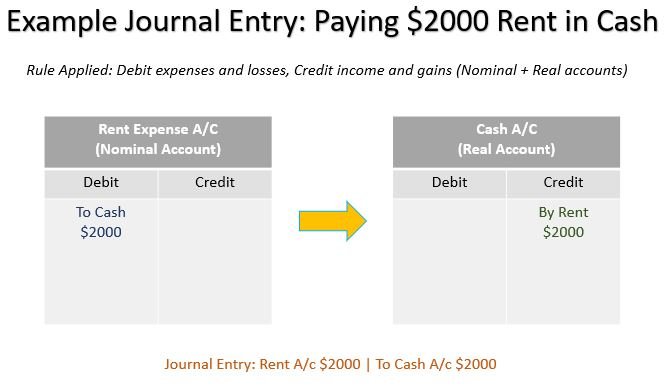
Example: Your business pays $2,000 in rent using cash. Rent is an expense, so the rent account is debited. Cash is an asset leaving the business, so the Cash account is credited.
Journal entry: Rent A/c Dr. $2,000 | To Cash A/c $2,000
This rule applies to salaries, utility bills, interest earned, commission received, and virtually every line item on a profit and loss statement. Once you’re comfortable with it, reading a company’s income statement becomes a much faster process.
How the Golden Rules Connect to the Accounting Equation
If you’ve studied finance even briefly, you’ve met the accounting equation: Assets = Liabilities + Equity. It’s worth connecting that equation to the golden rules, because they’re really two views of the same system.
Real accounts map onto assets. Personal accounts often map onto liabilities and equity, since they represent what a business owes to lenders, owners, or suppliers. Nominal accounts feed into equity indirectly, because profit, which is income minus expenses, ultimately increases retained earnings. So when you apply the golden rules correctly on a transaction-by-transaction basis, the accounting equation stays balanced automatically. That’s not a coincidence. It’s the entire point of the system.
This is also why the golden rules matter so much for MBA students and financial advisors, not just bookkeepers. Understanding this connection makes it far easier to read a balance sheet, forecast cash flow, or explain to a client why a single transaction shows up in two different places on a financial statement.
Why These Rules Still Matter in a Software-Driven World
You might be wondering: if QuickBooks, Xero, SAP, and Tally already handle debits and credits automatically, why bother learning the golden rules at all? Fair question. Here’s the honest answer.
Software doesn’t understand your business. It only executes what a human tells it to. Someone still has to classify each transaction correctly, choose the right account, and catch errors when a report doesn’t look right. That someone needs to understand the golden rules, not just trust a dropdown menu.
Auditors also rely on this logic to trace transactions and spot fraud. Investors use it to sanity-check financial statements before writing a check. And frankly, hiring managers still ask about the golden rules in interviews, because they reveal whether a candidate actually understands accounting or has just memorized software shortcuts.
There’s a practical angle here too. When a report doesn’t balance, or when a client questions why an expense shows up where it does, the golden rules give you a fast, defensible way to explain the entry. That kind of clarity builds trust, whether you’re presenting to a CFO in one country or a small business owner in another country.
How These Rules Apply Across the World.
Here’s something worth knowing: the golden rules of accounting aren’t tied to one country’s tax code or reporting standard. They describe the mechanics of double-entry bookkeeping itself, which sits underneath every major framework in use today.
So no matter where you plan to work, whether that’s a Big Four firm in New York, a fintech startup in Dubai, or a manufacturing company in Singapore, this foundation travels with you.
Common Mistakes People Make With the Golden Rules
Even experienced professionals slip up sometimes. Here are the mistakes that come up most often, along with quick fixes.
- Misclassifying the account type. If you’re unsure whether something is a real or nominal account, ask yourself: does this item carry a balance into next year? If yes, it’s real. If it resets, it’s nominal.
- Confusing debit and credit with increase and decrease. Debit and credit are positions, not judgments. A debit increases an asset but decreases a liability. Context matters.
- Forgetting that every entry needs two sides. If your books don’t balance, you’ve likely recorded only one side of a transaction.
- Applying personal account logic to a company’s own cash account. Cash is a real account, not a personal one, even though it can feel similar in practice.
A Simple Memory Trick for the 3 Golden Rules
If you’re studying for an exam or training a new hire, mnemonics help. Try this one:
“Receiver Debits, Giver Credits, What Comes In Debits, What Goes Out Credits, Expenses Debits, Income Credits.”
Say it a few times, and it starts to stick. Better yet, write out five transactions from your own daily life, like a rent payment, a salary credit, or a grocery purchase, and classify each one using the three rules. Active practice beats passive reading every time.
Frequently Asked Questions
Can you tell us what are the 3 golden rules of accounting?
The three golden rules of accounting are (1) debit the receiver, credit the giver, for personal accounts; (2) debit what comes in, credit what goes out, for real accounts; and (3) debit all expenses and losses, credit all incomes and gains, for nominal accounts.
Why are they called ‘golden’ rules?
They’re called golden rules because they form the unshakeable foundation of double-entry bookkeeping. Just as gold represents lasting value, these rules have guided accurate financial recordkeeping for centuries and still apply today.
Are the golden rules used in modern accounting software?
Yes, indirectly. Software like QuickBooks or SAP applies these rules automatically behind the scenes. However, the person entering or reviewing transactions still needs to understand them to classify entries correctly and catch errors.
Do the golden rules apply under IFRS and US GAAP?
Yes. The golden rules describe the mechanics of recording transactions through debits and credits. Both IFRS and US GAAP sit on top of this same double-entry foundation, even though their reporting and disclosure requirements differ.
Who created the golden rules of accounting?
The golden rules are a teaching framework built on the double-entry bookkeeping system that Luca Pacioli documented in 1494. Pacioli didn’t invent the practice; he recorded a method already used by Venetian merchants, and educators later distilled it into the three rules taught today.
Do the golden rules apply to small businesses and freelancers, or only large companies?
They apply to any entity that keeps double-entry books, regardless of size. A freelancer invoicing a client, a small retailer tracking inventory, and a multinational corporation all use the same three rules to record their transactions correctly.
Key Takeaways
- The three fundamental principles of accounting steer all debit and credit choices in double-entry bookkeeping.
- Personal accounts: debit the receiver, credit the giver.
- Real accounts: debit what comes in, credit what goes out.
- Nominal accounts: debit all expenses and losses, credit all incomes and gains.
- These rules apply globally, across the USA, Europe, Asia, and the Middle East, regardless of which reporting framework a company follows.
- Understanding the logic behind each rule matters more than memorizing it, especially once software starts doing the entries for you.
Conclusion
The three golden rules of accounting aren’t just textbook material. They’re the quiet logic running behind every financial statement you’ll ever read or prepare. Learn them well, and balance sheets stop feeling like a foreign language. Instead, they start reading like a story, one where every debit has a credit, and every transaction has a reason.
Bookmark this guide, come back to it when you’re stuck on a tricky entry, and share it with anyone starting their accounting journey. Once these rules click, they never really leave you.