
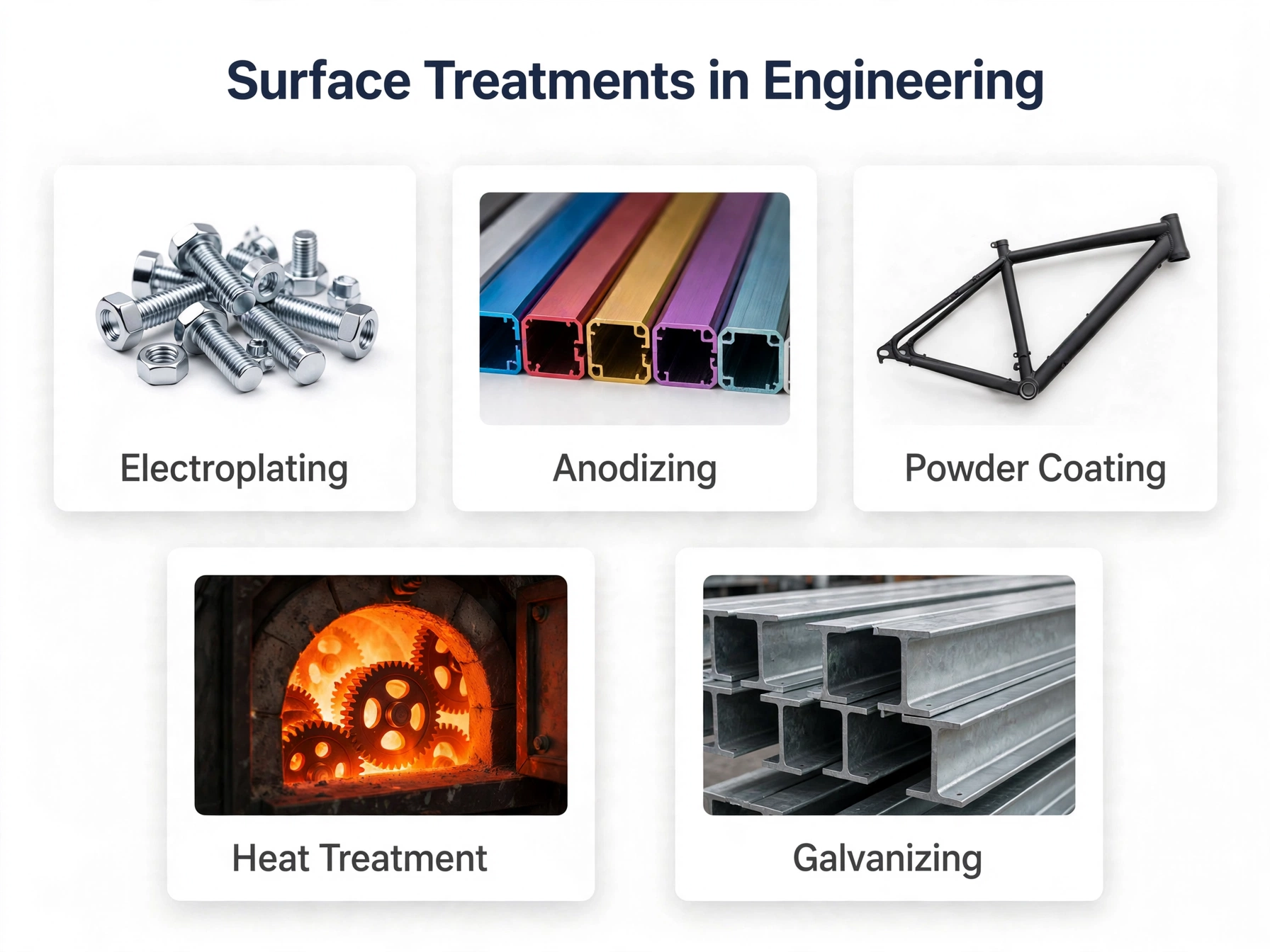
Every engineer faces the same question at some point: how do you protect a metal part from rust, wear, or fatigue? Surface treatments answer that question. They change the outer layer of a material without touching its core. As a result, engineers get better corrosion resistance, higher hardness, and a longer service life, all without redesigning the part.
This guide covers the five core surface treatments used in modern manufacturing: electroplating, anodizing, powder coating, heat treatment, and galvanizing. Additionally, it explains where nitriding, plasma treatment, and other advanced surface treatments fit in. Whether you work at a surface treatment factory in Ohio, an aerospace plant in Toulouse, an automotive line in Seoul, or a construction firm in Dubai, the selection principles stay the same. Use this guide as your reference the next time you need to choose a surface treatment for metal, steel, or aluminium parts.
What Is Surface Treatment?
Surface treatment is any process that changes the surface properties of a material. It does not change the bulk material underneath. Instead, it modifies only the outer layer. Consequently, engineers use surface treatments to solve specific problems: corrosion, wear, poor adhesion, or low hardness.
Surface finishing is a closely related term. In fact, many engineers use “surface finishing” and “surface treatment” interchangeably. A metal surface finishing line in a factory typically applies cleaning, treatment, and coating steps in sequence. Furthermore, most surface finishings fall into one of two categories: those that add a coating, such as electroplating, galvanizing, and powder coating, and those that change the existing surface chemistry or structure, such as anodizing, heat treatment, and nitriding.
Why Surface Treatments Matter Across Industries
Surface treatments matter because untreated metal fails fast. Steel rusts. Aluminium corrodes under salt exposure. Bare parts wear out quickly under friction. Therefore, nearly every industry relies on surface treatments to extend part life.
In the automotive sector, surface treatments protect body panels, fasteners, and engine components from corrosion and wear. Automotive surface treatments also improve paint adhesion and give vehicles a premium finish. Similarly, in the aerospace sector, surface treatments handle extreme demands. Aerospace surface treatments must resist fatigue, high-altitude corrosion, and temperature swings, all while keeping the part as light as possible.
Meanwhile, the construction industry depends on a very different kind of surface treatment: asphalt surface treatment. Chip seals and surface dressings protect road pavement from water infiltration and traffic wear. In addition, high friction surface treatments improve skid resistance at intersections, roundabouts, and airport runways, an application where safety, not appearance, drives the decision.
Also, across the Middle East, oil and gas infrastructure needs steel surface treatments that resist heat and corrosive environments. In Asia and Europe, electronics manufacturers rely on advanced surface treatments for connectors and housings. In short, surface treatment is not a niche process. It is foundational to nearly every branch of engineering, everywhere in the world.
Types of Surface Treatments for Metals
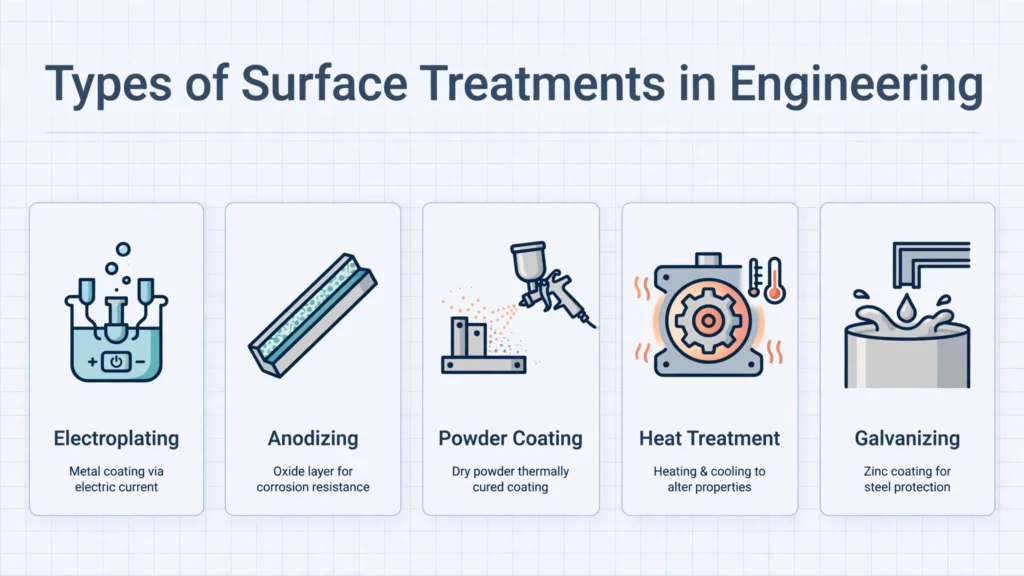
Manufacturers use dozens of surface treatment methods today. However, five processes form the backbone of most metal finishing lines: electroplating, anodizing, powder coating and painting, heat treatment, and galvanizing. Below, we explain each process step by step, so you can match the right method to your application.
1. Electroplating
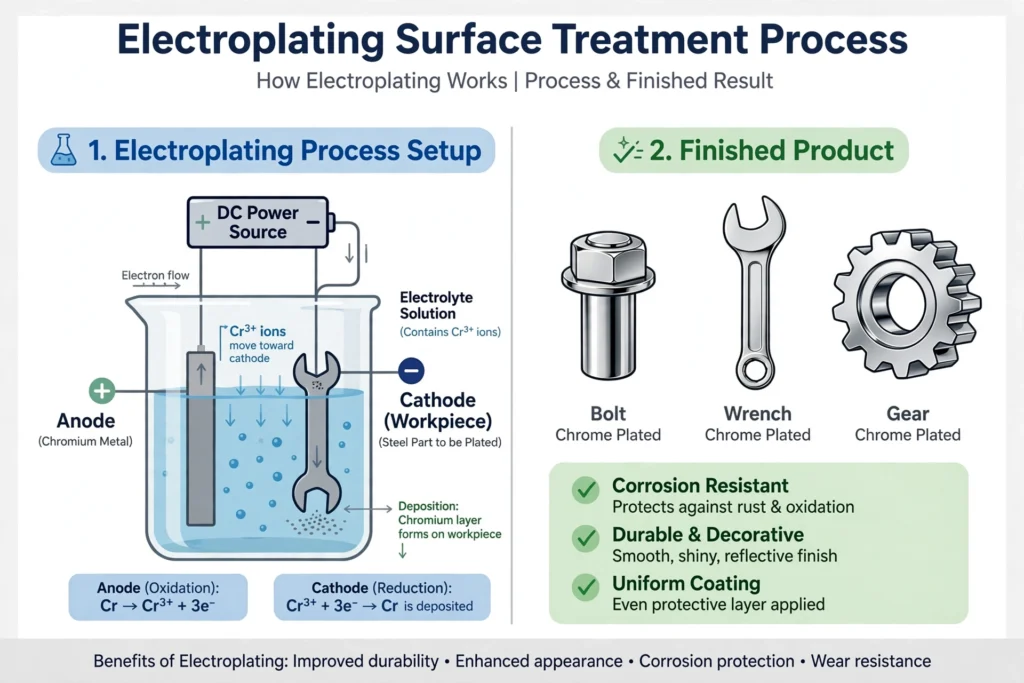
Electroplating deposits a thin layer of metal onto a workpiece using an electric current. Common plating metals include chromium, nickel, zinc, copper, and gold. Engineers choose electroplating when they need corrosion resistance, wear resistance, electrical conductivity, or a decorative finish.
The electroplating process works like this:
- Firstly, clean and degrease the part. Any oil, dirt, or oxide layer will ruin adhesion, so this step is critical.
- Secondly, activate the surface with an acid dip. This step removes any remaining oxide film and prepares the metal for bonding.
- Then immerse the part in an electrolyte bath alongside an anode made of the plating metal.
- Later, apply a direct current. The current pulls metal ions from the anode and deposits them onto the workpiece, which acts as the cathode.
- Finally, rinse, dry, and inspect the finished part for thickness and coverage.
Electroplating shows up everywhere: automotive trim, electrical connectors, aerospace fasteners, and household hardware. Moreover, plating thickness and metal choice change performance dramatically, so engineers must specify both carefully. A surface treatment factory running electroplating lines typically controls bath chemistry, current density, and time to hit exact thickness targets.
2. Anodizing
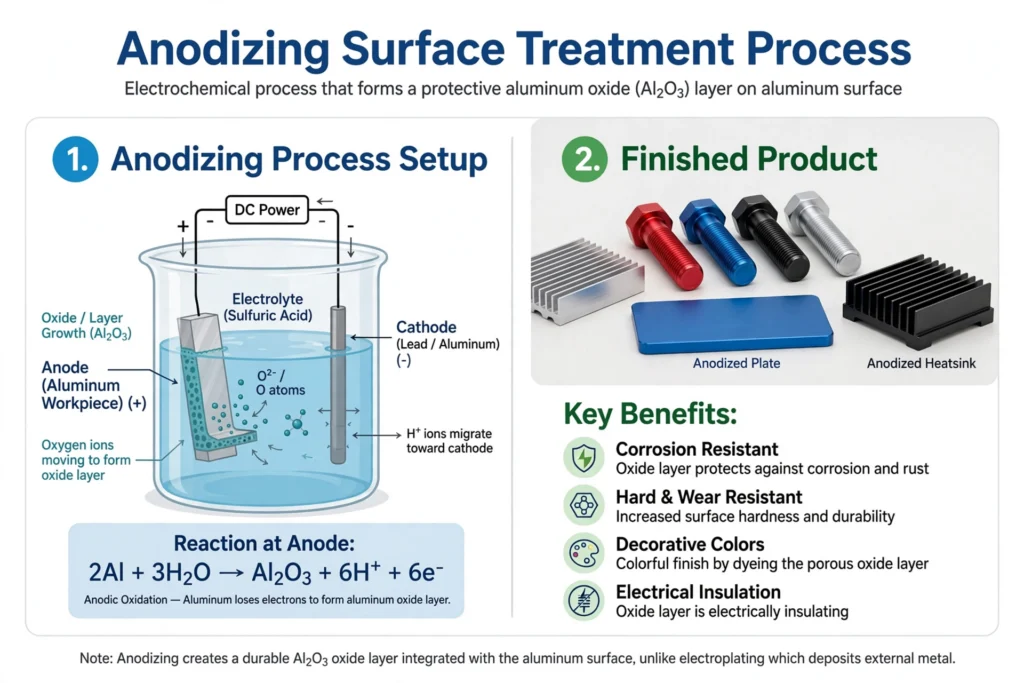
Anodizing is one of the most common aluminium surface treatments in the industry. Unlike electroplating, anodizing does not add a coating. Instead, it grows a controlled oxide layer directly from the base metal. As a result, the finish bonds permanently to the part and cannot peel or flake off.
The anodizing process follows these steps:
- Initially clean the aluminium surface to remove oils and contaminants.
- Then etch the part in an alkaline bath to create a uniform surface texture.
- later anodize the part in an acid electrolyte, usually sulfuric acid, using a direct current. The aluminium acts as the anode, ultimately oxygen ions form a porous oxide layer on its surface.
- Dye the part, if color is required. The porous oxide layer absorbs dye easily at this stage.
- At last seal the pores, typically in hot water or a nickel acetate solution, to lock in color and boost corrosion resistance.
Engineers use Type II anodizing for general corrosion protection and color, while Type III, or hardcoat anodizing, delivers extra wear resistance for structural or high-friction applications. Aluminum surface treatment via anodizing is standard across aerospace, electronics, and architectural industries because it is lightweight, durable, and consistent.
3. Powder Coating and Painting
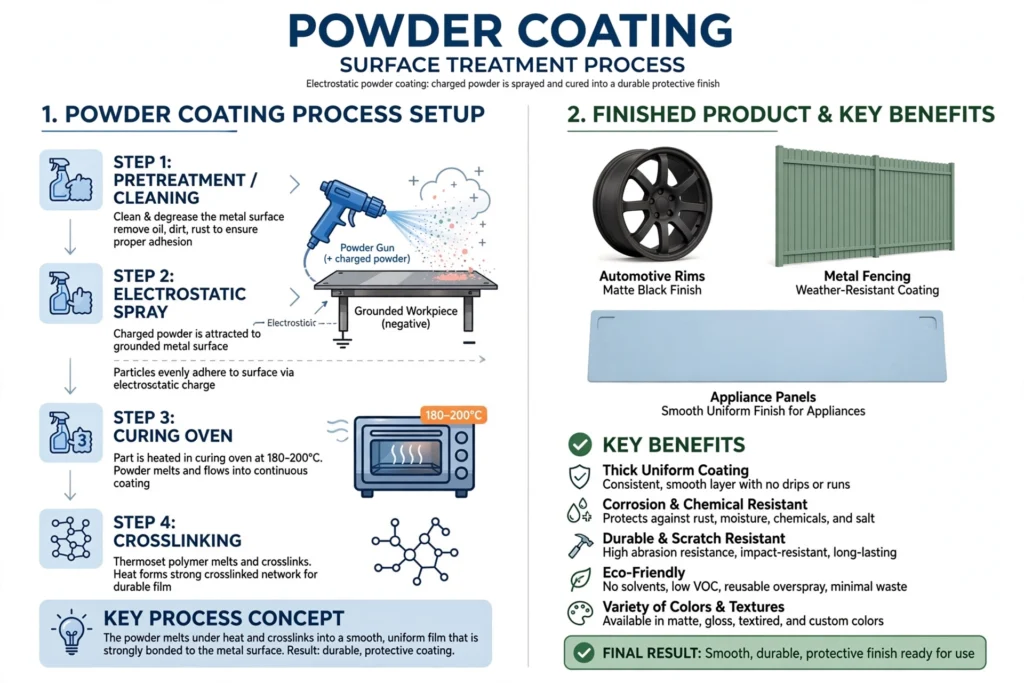
The powder coating and painting protect metal surfaces while giving them color and texture. Powder coating uses a dry powder, applied electrostatically, then cured under heat. Painting, on the other hand, applies a liquid coating that dries or cures at room temperature or in an oven.
Powder coating process steps:
- At first, prepare the surface. This usually includes cleaning and a conversion coating, such as phosphate or chromate, to boost adhesion.
- Then apply the powder using an electrostatic spray gun. The charged powder particles cling to the grounded metal part.
- Following this, cure the part in an oven, typically between 160°C and 200°C. Heat melts and fuses the powder into a smooth, continuous film.
- Lastly, cool and inspect the coated part for coverage, thickness, and finish quality.
Generally for liquid painting, the process adds a few extra steps: primer application, filler application where needed, topcoat spraying, and a clear coat for extra gloss and protection. In fact, fillers and waxes for surface treatments play a big role in automotive body shops, where they smooth minor surface imperfections before paint goes on.
Especially automotive sector surface treatments rely heavily on both methods. Powder coating suits wheels, brackets, and outdoor equipment, while liquid painting remains the standard for automotive body panels that need a flawless, glossy finish.
4. Heat Treatment
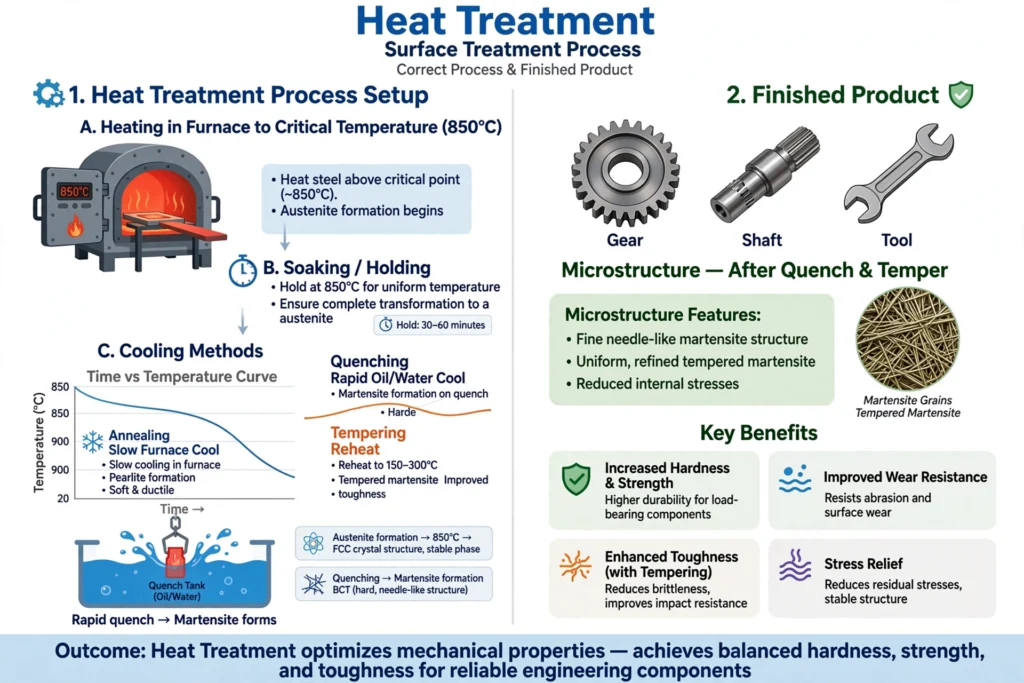
Heat treatment changes the internal microstructure of a metal by heating and cooling it under controlled conditions. Unlike coatings, heat treatment affects more than just the surface, although several heat treatment variants, such as case hardening and nitriding, focus specifically on the surface layer.
Common heat treatment processes include:
- Annealing — Heat the metal, then cool it slowly. This softens the metal, relieves internal stress, and improves ductility.
- Quenching — Heat the metal to its austenitizing temperature, then cool it rapidly in oil, water, or air. This increases hardness significantly.
- Tempering — Reheat a quenched part to a lower temperature. This reduces brittleness while keeping most of the added hardness.
- Case Hardening — Harden only the outer surface, while the core stays tough and ductile. Carburizing and nitriding are the two most common case-hardening methods.
Nitriding surface treatment deserves special attention here, since it is one of the most requested surface treatments for steel. Nitride surface treatment diffuses nitrogen atoms into the steel surface at relatively low temperatures, around 500°C to 550°C, forming a hard nitride layer without the distortion risk of quenching. Manufacturers apply nitriding through gas nitriding, salt bath nitriding, or plasma nitriding.
Plasma surface treatment equipment ionizes nitrogen gas inside a vacuum chamber, creating plasma that bombards the part with nitrogen ions. So, what is plasma surface treatment good for? It delivers excellent hardness, minimal distortion, and precise control over case depth, which is why gear manufacturers and toolmakers favor it. Heat treatment, overall, is essential wherever steel surface treatments must meet high load, fatigue, or wear demands, from automotive gears to aerospace landing gear components.
5. Galvanizing
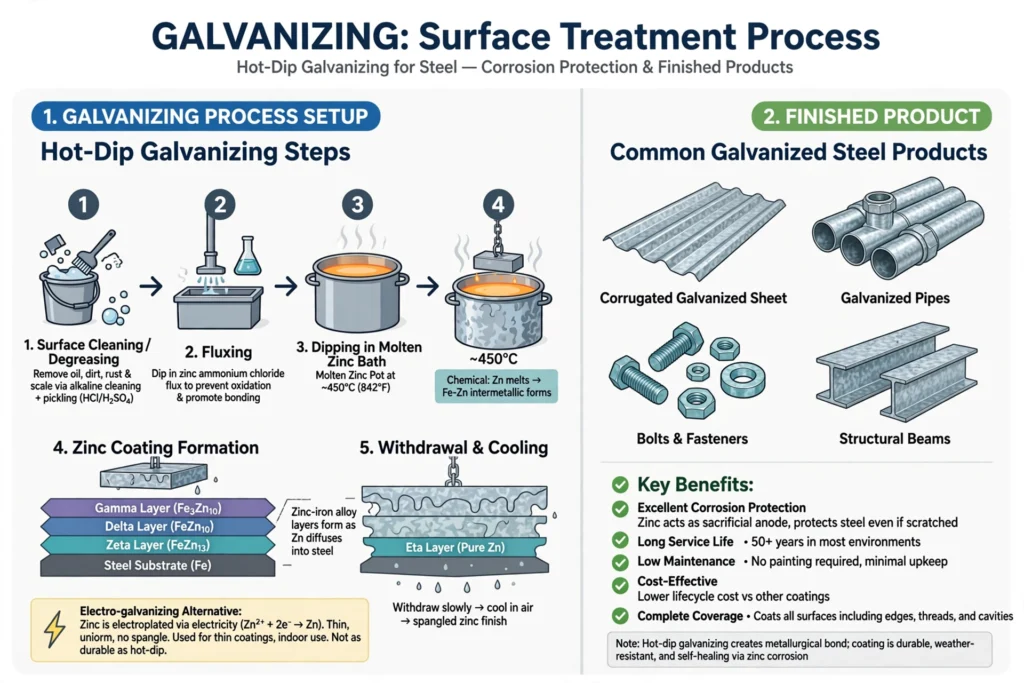
Galvanizing coats steel with a layer of zinc to prevent rust. Zinc protects steel in two ways. First, it acts as a physical barrier against moisture and oxygen. Second, it works as a sacrificial anode: if the coating gets scratched, the zinc corrodes first and protects the exposed steel underneath.
Hot-dip galvanizing process steps:
- Degrease the steel to remove oil and grease.
- Pickle the part in an acid bath to remove rust and mill scale.
- Flux the surface to prevent oxidation before dipping and to help the zinc bond properly.
- Dip the part into a bath of molten zinc, heated to roughly 450°C.
- Cool and inspect the galvanized coating for thickness and uniformity.
Electrogalvanizing offers an alternative. It uses an electric current to deposit a thinner, more uniform zinc layer, similar to electroplating. However, hot-dip galvanizing generally provides thicker, more durable protection, which is why it remains the standard for structural steel, guardrails, and outdoor infrastructure across construction projects worldwide.
Other Notable Surface Treatments You Should Know
Beyond the five core processes, several other surface treatments show up often in real-world engineering:
- Asphalt surface treatment — Road engineers apply chip seals and surface dressings to protect asphalt pavement from water infiltration and traffic wear. These treatments extend road life at a fraction of the cost of full repaving.
- Surface mold treatment — Injection molds need their own surface treatment, usually a hard coating or texture, to resist wear from repeated cycles and to improve part release. This keeps production lines running smoothly.
- High friction surface treatments—Traffic engineers apply high friction surfacing at accident-prone junctions, roundabouts, and airport runways. These treatments boost skid resistance and improve safety.
- Stainless steel surface treatments — Passivation and electropolishing remove free iron from the surface and smooth out microscopic peaks, which boosts corrosion resistance in food, medical, and pharmaceutical equipment.
Advanced surface treatments continue to evolve, too. Plasma treatments, laser surface hardening, and physical vapor deposition, or PVD, coatings now serve industries that need extreme precision, from semiconductor manufacturing to aerospace turbine blades.
How to Select the Right Surface Treatment
Choosing the correct surface treatment is not guesswork. Instead, it depends on a handful of clear factors. Consider these questions before you select a process:
- What is the base material? Aluminium surface treatments, such as anodizing, differ from steel surface treatments, such as galvanizing and heat treatment, and from stainless steel surface treatments, such as passivation.
- What environment will the part face? Outdoor, marine, or chemical exposure calls for stronger corrosion protection, such as galvanizing or hardcoat anodizing.
- What mechanical demands apply? High-wear or high-load parts often need heat treatment, case hardening, or nitriding.
- Does appearance matter? Powder coating and painting deliver color and finish quality where looks and branding matter.
- What industry standards apply? Aerospace and automotive sectors often require certified processes and traceable quality control.
- What is the budget and timeline? Some treatments, like anodizing, run faster and cheaper than multi-step heat treatment cycles.
Use the table below as a fast reference for common material-to-treatment pairings:
| Base Material | Primary Goal | Recommended Treatment |
| Aluminium | Corrosion resistance + color | Anodizing |
| Carbon steel | Corrosion protection (outdoor) | Hot-dip galvanizing |
| Alloy steel | Surface hardness + wear resistance | Nitriding / Case hardening |
| Stainless steel | Corrosion resistance (hygienic use) | Passivation / Electropolishing |
| Any metal | Decorative finish + light protection | Electroplating |
| Any metal | Color + medium corrosion protection | Powder coating |
Final Thoughts
Surface treatment selection shapes how long a part lasts, how it performs, and how it looks. Ultimately, the right choice depends on the base metal, the operating environment, and the mechanical demands the part will face. Electroplating, anodizing, powder coating, heat treatment, and galvanizing cover most real-world applications. However, specialized processes like nitriding, plasma treatment, asphalt surface treatment, and high friction surfacing solve more specific problems.
Whether you are a student studying manufacturing processes, an engineer specifying a coating for a new part, or a professional running a surface treatment factory, use this guide as your quick reference. Compare your material, environment, and performance needs against the table above, and you will land on the right surface treatment every time.